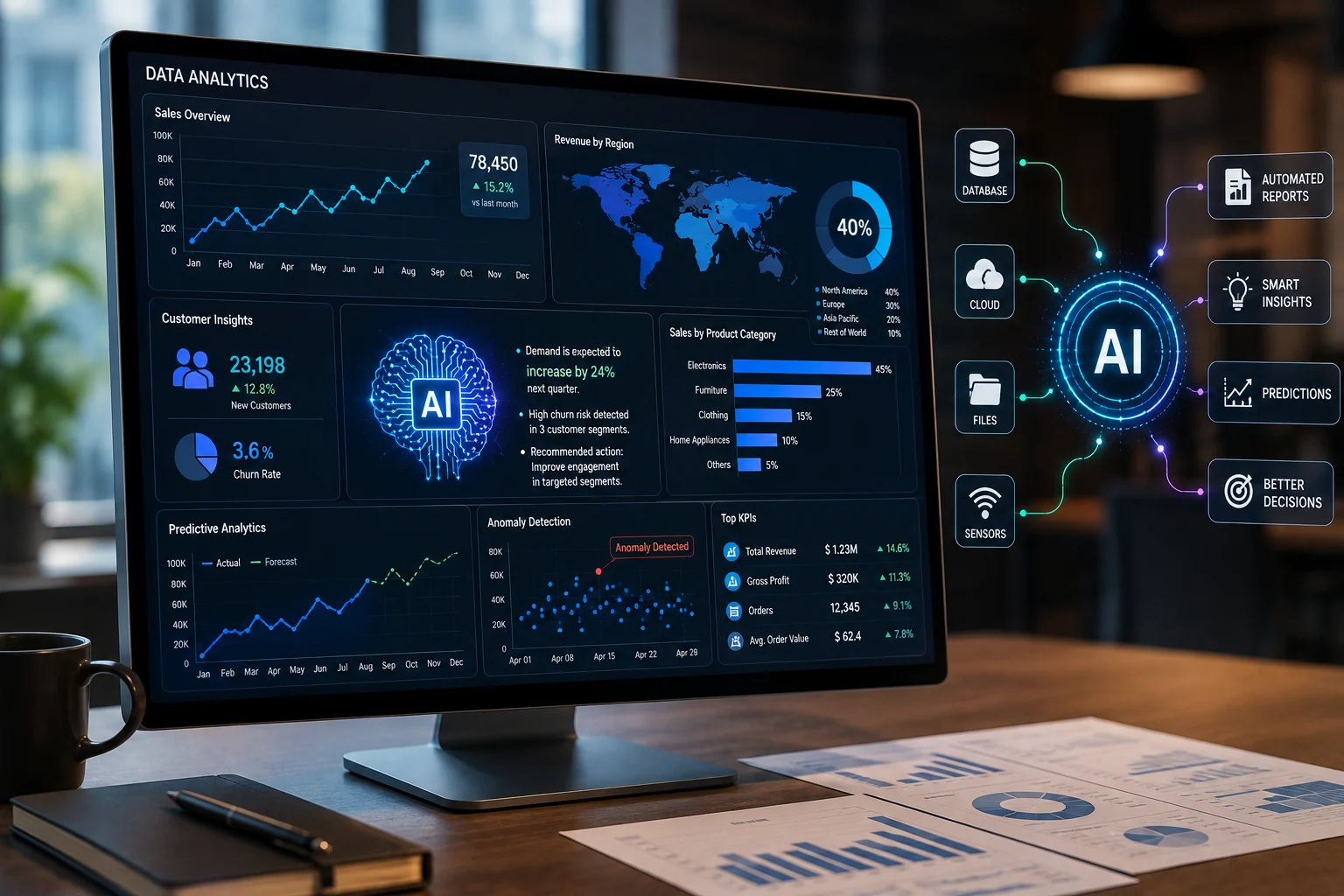
Data Visualization plays a critical role in helping businesses turn raw numbers into clear, actionable insights. According to McKinsey, data-driven organizations are significantly more likely to acquire customers and improve profitability compared to their competitors. The difference often comes down to how effectively companies interpret and present their data. This article explains how businesses use visual reporting to improve decisions, efficiency, and long term growth.
Why Businesses Struggle Without Data Visualization
Many businesses rely heavily on spreadsheets and static reports. While those tools serve a purpose, they often slow teams down.
Large datasets buried inside rows and columns make it difficult to identify trends. Managers may spend hours reviewing reports only to miss patterns that could have been spotted in seconds through a visual dashboard.
Data silos create another challenge. Sales, marketing, finance, and operations may each maintain separate reports. When numbers conflict, decision-making becomes delayed and unclear. Without a shared visual system, alignment across departments becomes harder than it needs to be.
Static Reports vs Interactive Dashboards
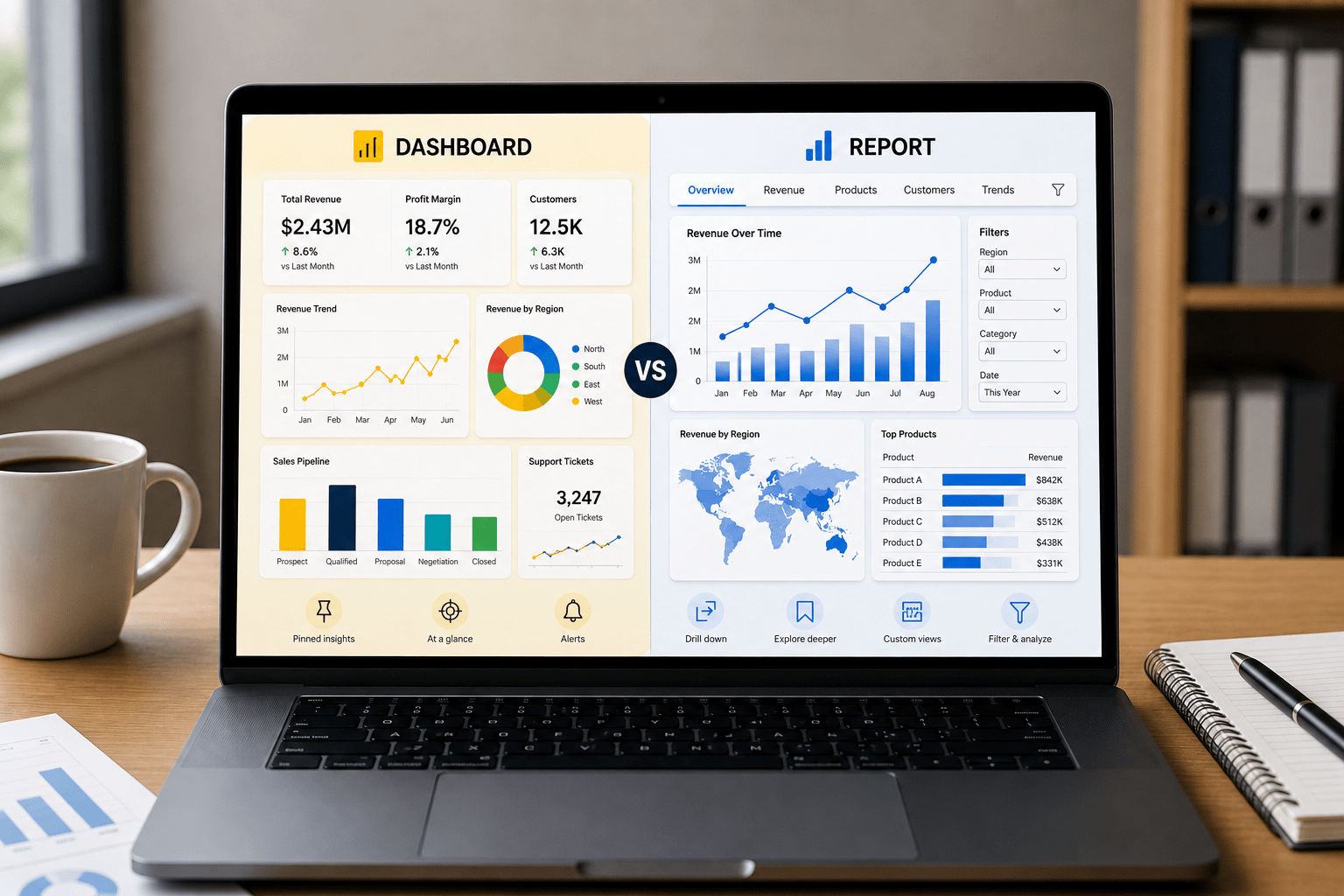
Static reports provide a fixed snapshot of performance. They usually require manual updates and are often outdated by the time leadership reviews them. Filtering options are limited, and deeper analysis requires building new reports from scratch.
Interactive dashboards offer a different experience. They update in real time and allow users to drill down into specific metrics. Executives can move from high-level summaries to detailed views within seconds. Instead of waiting for weekly reports, they can monitor performance continuously.
This flexibility allows teams to respond faster and with greater confidence.
How Data Visualization Improves Business Decision Making
One of the strongest benefits of Data Visualization is faster executive decision-making.
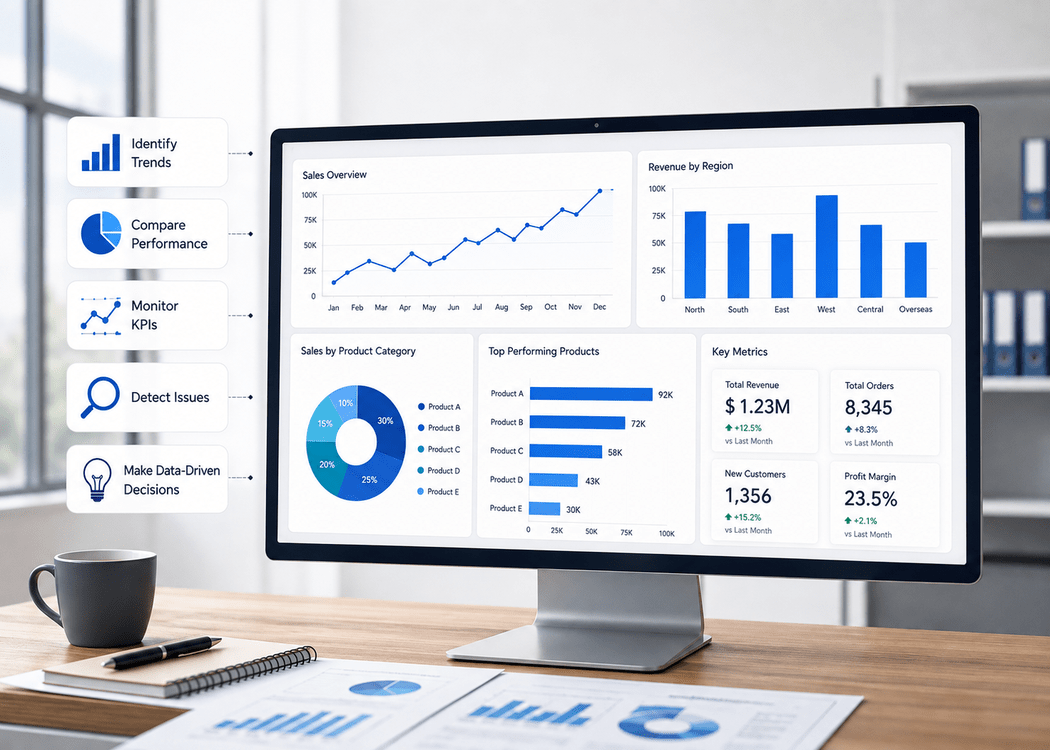
When key performance indicators are presented clearly, leaders can identify trends immediately. Revenue growth, customer churn, cost fluctuations, and sales performance become visible at a glance. This reduces meeting time and minimizes confusion around numbers.
Clear KPI visibility also improves accountability. Teams know exactly which metrics matter and how their performance contributes to overall business goals. When everyone works from the same dashboard, there is less room for interpretation and more focus on execution.
Data Visualization and Operational Efficiency
Operational inefficiencies often hide inside complex datasets.
Visual dashboards highlight bottlenecks quickly. For example, supply chain delays may appear as trend shifts in fulfillment times. Customer service backlogs can be identified through queue visualization. Workflow slowdowns become easier to diagnose when process data is mapped clearly.
Real-time monitoring further strengthens efficiency. Sales dashboards updated daily help managers adjust strategies before monthly targets are missed. Inventory visuals prevent overstocking or unexpected shortages. Production metrics displayed visually support proactive maintenance and planning.
Instead of reacting to problems after they grow, businesses can address them early.
Supporting Sales and Marketing Growth
Sales and marketing teams rely heavily on performance data. Without clear visualization, campaign analysis becomes time-consuming and fragmented.
Visual insights reveal customer purchasing patterns, geographic trends, and product demand shifts. This helps refine targeting strategies and identify high-value segments.
Campaign performance is easier to evaluate when conversion funnels and ROI comparisons are displayed visually. Teams can quickly see which channels drive results and which require optimization. Marketing budgets can then be allocated more effectively.
When decisions are based on clear visual evidence, growth becomes more predictable.
Financial Planning and Risk Management
Financial clarity is essential for stability and expansion.
Trend lines and historical comparisons support more accurate revenue forecasting. Leaders can evaluate seasonal patterns, cost behavior, and long-term growth trajectories through visual reporting.
Risk detection becomes stronger as well. Expense anomalies, budget overruns, or unexpected cash flow fluctuations stand out clearly on dashboards. This allows finance teams to act before small issues become larger financial problems.
By making financial performance transparent, businesses gain stronger control over planning and risk management.
Measuring the ROI of Data Visualization
Business leaders often ask one direct question: What is the return?
The return on Data Visualization can be measured in several ways:
- Reduced time spent preparing reports
- Faster executive decision cycles
- Improved forecasting accuracy
- More efficient marketing spend
- Higher operational productivity
When reporting becomes automated and centralized, teams spend less time gathering data and more time analyzing it. Over time, this shift improves both performance and profitability.
Data Accuracy and Governance Matter
Effective visualization depends on reliable data.
If datasets are incomplete, outdated, or inconsistent, dashboards can mislead decision makers. That is why proper data governance is essential. Businesses must ensure clean data sources, validated integrations across systems such as CRM and ERP platforms, and regular updates.
Data security and compliance should also be considered. Financial and customer information must be handled responsibly and stored securely.
Visualization tools are powerful, but their value depends entirely on the quality of the information behind them.
Real Business Use Cases
Retail companies use inventory dashboards to track product movement. Visual insights help prevent stockouts during peak demand and reduce excess inventory that ties up capital.
Healthcare organizations rely on patient flow dashboards to improve scheduling and resource allocation. Clear visual metrics help reduce wait times and improve service delivery.
SaaS companies monitor subscription growth and churn trends through visual analytics. When churn patterns become visible early, product and support teams can respond before revenue is affected.
These examples show how visual reporting supports different industries in practical ways.
Best Practices for Implementing Data Visualization in Business
Businesses can maximize results by following clear implementation principles:
- Define business objectives before building dashboards
- Focus on clarity and simplicity rather than visual complexity
- Avoid overcrowding reports with unnecessary metrics
- Use consistent and verified data sources
- Train teams to interpret insights accurately
- Review dashboards regularly to ensure relevance
Following these steps ensures that visualization remains aligned with business goals.
When Businesses Should Consider Professional Support
As organizations grow, their data environment becomes more complex.
Companies managing multiple systems may struggle with integration challenges. Custom dashboards tailored to specific KPIs often require technical expertise. Scaling analytics across departments also demands careful planning.
Professional support becomes valuable when businesses need advanced integrations, secure data architecture, and dashboards designed around measurable outcomes.
If your organization needs customized dashboards aligned with measurable goals, explore professional Data Visualization Services to build reporting systems that support smarter decisions.
Read Also: Why Is Data Visualization Important In High-Data Industries
Conclusion
Data Visualization helps businesses improve decision-making, strengthen operational efficiency, enhance marketing performance, and manage financial risks more effectively. When implemented thoughtfully and supported by reliable data, it becomes a foundation for sustainable growth.
Organizations that invest in clear, structured visual reporting gain better control over their performance and future direction. For businesses seeking structured analytics solutions, OzaIntel provides the expertise needed to translate complex data into meaningful business outcomes.
FAQs
Data visualization presents key metrics in a clear format, allowing leaders to identify trends, risks, and opportunities quickly. Instead of reviewing lengthy reports, executives can make informed decisions based on real-time insights.
Any business that collects performance data can benefit. Retail, healthcare, SaaS, finance, manufacturing, and eCommerce companies often see strong results because they rely heavily on KPIs, forecasting, and operational tracking.
Many businesses notice improvements within the first few months, especially in reporting speed and decision clarity. Long term benefits such as improved forecasting and efficiency typically become more measurable over time.
Costs vary depending on complexity and integration needs. Small and mid sized businesses can start with focused dashboards that track core KPIs, then expand as their data maturity grows.
Accuracy depends on clean data sources, proper system integration, and regular validation. Businesses should establish clear data governance policies and monitor updates to maintain reliability.
If your team has strong technical expertise and simple data structures, internal development may work. However, companies managing multiple systems or requiring custom integrations often benefit from professional support to ensure scalability and security.
Security depends on how dashboards are built and where data is stored. Businesses should ensure proper access controls, encrypted connections, and compliance with industry regulations. It is important to limit access based on roles and responsibilities.
Yes, most modern visualization platforms can integrate with CRM, ERP, marketing automation, and financial systems. Proper integration ensures that dashboards reflect real time and accurate data across departments.
Businesses can measure impact by tracking reporting time reduction, faster decision cycles, improved forecasting accuracy, and clearer KPI alignment. Comparing performance metrics before and after implementation helps quantify value.
Common mistakes include overcrowding dashboards with too many metrics, ignoring data quality, failing to train teams, and treating visualization as a one-time project instead of an ongoing process.