Sales forecasting has always been a cornerstone of strategic business planning. Yet, many companies still rely on outdated spreadsheets or limited CRM reporting, which often fail to capture changing market trends or customer behavior. The rise of artificial intelligence is transforming this process, enabling organizations to make data-backed, dynamic, and highly accurate forecasts within their existing CRM systems.
This article explains how to integrate AI-driven sales forecasting into your current CRM setup, the benefits it delivers, and the practical steps for implementation.
Understanding AI-Driven Sales Forecasting
AI-driven forecasting uses machine learning algorithms to analyze historical sales data, customer interactions, and market variables to predict future outcomes. Unlike traditional models that only look backward, AI continuously learns from new information to refine its predictions.
These models process large volumes of structured and unstructured data, everything from deal sizes and win rates to sentiment in customer communications. The result is a forecast that adapts to real-time conditions and provides actionable insights for your sales teams.
Why Traditional CRM Forecasting Falls Short
Most CRMs provide basic forecasting features based on past performance or sales reps’ manual input. While helpful for tracking pipelines, they don’t account for external factors like seasonality, competition, or economic shifts.
Manual forecasts are often static and prone to human bias, making them less reliable for strategic decisions. Integrating AI eliminates guesswork by identifying hidden patterns and correlations that may not be visible to sales teams.
Benefits of AI-Driven Forecasting in CRM Systems
1. Greater Forecast Accuracy
AI models learn from historical performance and ongoing activity to deliver highly accurate projections. They detect subtle patterns in lead conversion, deal velocity, and buying behavior factors that are easy for humans to overlook.
2. Real-Time Insights
Instead of monthly or quarterly updates, forecasts refresh continuously as new data flows into the CRM. This allows sales leaders to react quickly to pipeline changes or market fluctuations.
3. Smarter Pipeline Management
AI helps identify high-probability opportunities and at-risk deals, enabling teams to prioritize their time and resources effectively.
4. Informed Decision-Making
Predictive insights guide leadership in setting quotas, allocating budgets, and optimizing campaigns based on expected outcomes rather than assumptions.
5. Stronger Customer Retention
By predicting churn or identifying upsell potential, AI empowers account managers to take proactive action before revenue loss occurs.
Key Steps to Implement AI-Driven Sales Forecasting in Your CRM
Step 1: Audit and Prepare Your CRM Data
Before implementing any model, evaluate the quality of your existing data. Ensure that customer records, deal histories, and pipeline details are accurate and up to date.
Merge data from multiple touchpoints, email, chat, social interactions, and marketing automation platforms to build a unified dataset for analysis.
Step 2: Choose the Right AI Platform or Model
Select a forecasting tool or framework that integrates smoothly with your CRM. Some CRMs offer built-in predictive modules, while others allow connections through APIs or third-party applications.
Your choice should depend on your company’s data volume, customization needs, and technical expertise.
Step 3: Train and Validate Predictive Models
Feed historical sales data into your chosen model to recognize recurring patterns such as seasonal fluctuations, lead-to-close ratios, and sales cycle length.
Run validation tests to measure accuracy and fine-tune the algorithm before applying it to live data. Consistent testing ensures forecasts remain trustworthy.
Step 4: Integrate Forecasts into CRM Dashboards
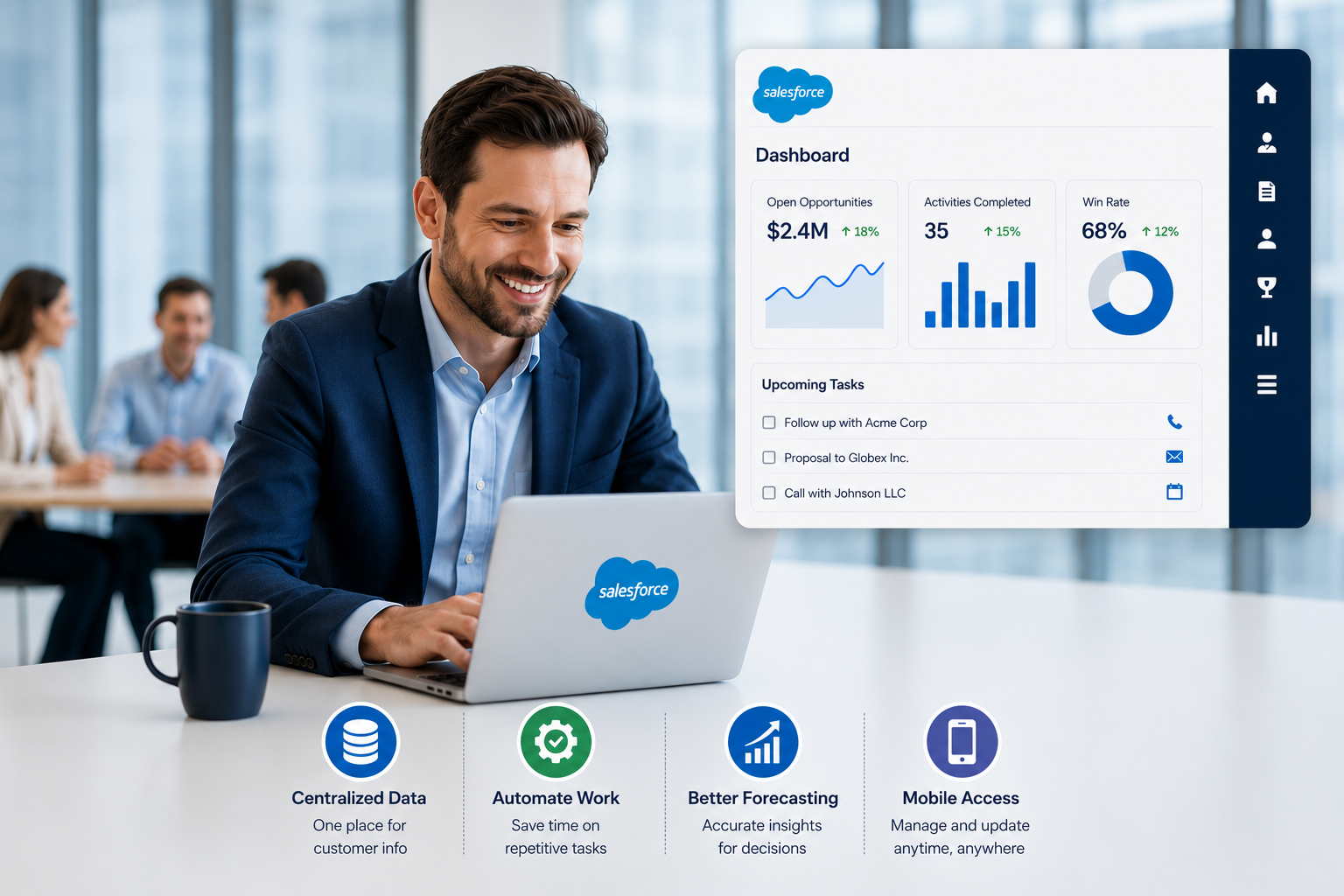
Visualizing predictions directly inside CRM dashboards helps sales teams make better daily decisions. Integrate real-time metrics such as probability of closing, projected revenue, and deal health scores.
Automation rules can also be set for example, alerting managers when a deal deviates significantly from forecasted outcomes.
Step 5: Monitor and Continuously Improve
AI models improve with feedback. Regularly review prediction accuracy and retrain the model with updated data. Encourage collaboration between sales and data teams to refine forecasting logic as business conditions evolve.
Common Challenges and How to Overcome Them
- Data Silos: Integrate all systems feeding customer and sales information. Unified data pipelines ensure models have complete visibility.
- User Adoption: Train your sales staff on how to interpret and apply AI-driven insights. Demonstrate the tangible benefits in accuracy and productivity.
- Model Bias or Overfitting: Regular audits and retraining prevent models from relying too heavily on outdated trends.
- Integration Complexity: Use standardized APIs or middleware tools to reduce friction during implementation. Partnering with experienced AI or CRM specialists can accelerate the process.
Real-World Applications and Use Cases
- Lead Prioritization: Machine learning ranks leads based on likelihood to convert, allowing sales reps to focus on the most promising prospects.
- Revenue Forecasting: Predict expected revenue for upcoming quarters with higher precision and adjust targets proactively.
- Churn Prediction: Identify customers likely to leave and trigger retention workflows.
- Territory Planning: Allocate territories or quotas based on predicted performance to balance workloads and maximize results.
These use cases highlight how AI transforms sales forecasting from a reactive process into a proactive growth engine.
Future Trends in AI and CRM Forecasting
The next generation of CRM forecasting will involve deeper automation and contextual intelligence. Self-learning models will adapt automatically as data changes, while predictive insights will extend beyond sales into customer success and finance.
Advances such as real-time market sentiment analysis and natural language processing will further refine forecast accuracy and strategic decision-making.
Turn Your CRM Data into Revenue-Driving Insights
Stop relying on static forecasts. Discover how AI and predictive analytics can help your sales team focus on what matters most: accurate forecasts, smarter decisions, and higher conversions. Integrate predictive intelligence into your CRM to uncover patterns, identify growth opportunities, and optimize every stage of your sales pipeline. Empower your teams with real-time visibility and data-driven insights that lead to measurable business growth and stronger customer relationships.
Let our experts help you implement the right AI strategy tailored to your goals and technology stack.
Conclusion
Implementing AI-driven forecasting in your CRM system is not just a technical upgrade; it’s a strategic shift toward data-backed decision-making. Start small by integrating predictive tools into existing workflows, measuring the results, and scaling as your teams grow comfortable with AI-supported processes.
Organizations that embrace intelligent forecasting today will gain sharper visibility into their pipelines, stronger customer relationships, and a more predictable path to revenue growth.