MarketsandMarkets projected that the predictive analytics market would grow from USD 10.5 billion in 2021 to USD 28.1 billion by 2026, a 21.7% compound annual growth rate. Other research firms publish different numbers, and Technavio, for example, forecasts a faster 33.6% CAGR for 2025 to 2030. The direction is the same in every forecast: more companies are paying to turn historical data into forward-looking decisions.
Predictive analytics consulting services help you do that without building a full data science team first. This guide covers what those services include, the benefits you can reasonably expect, the solutions consultants build, use cases by industry, how an engagement runs, and how to choose a partner. Every statistic below comes from a named public source, and where the evidence is thin, the article says so.
What Predictive Analytics Consulting Services Actually Include
Predictive analytics in simple language
Predictive analytics uses historical data, statistics, and machine learning to estimate what is likely to happen next. Most business projects fall into three task types:
- Forecasting a number: next quarter’s demand, next month’s revenue, tomorrow’s call volume.
- Classifying an outcome: will this customer cancel, will this invoice be paid late, will this machine fail?
- Scoring and ranking: which leads deserve a call first, which accounts carry the most risk.
What consultants do that tools and in-house teams often don’t
Software can run a model. It cannot decide which question is worth asking. A consultant typically covers five jobs:
- Turns a vague goal (“reduce churn”) into a measurable prediction target.
- Audits your data for gaps, bias, and inconsistent definitions.
- Builds, compares, and validates models.
- Connect predictions to the tools your team already uses.
- Trains your staff and documents the work so it survives staff turnover.
Many teams start with broader data analytics services to fix reporting and data foundations before they add predictive models on top.
How predictive analytics differs from other types
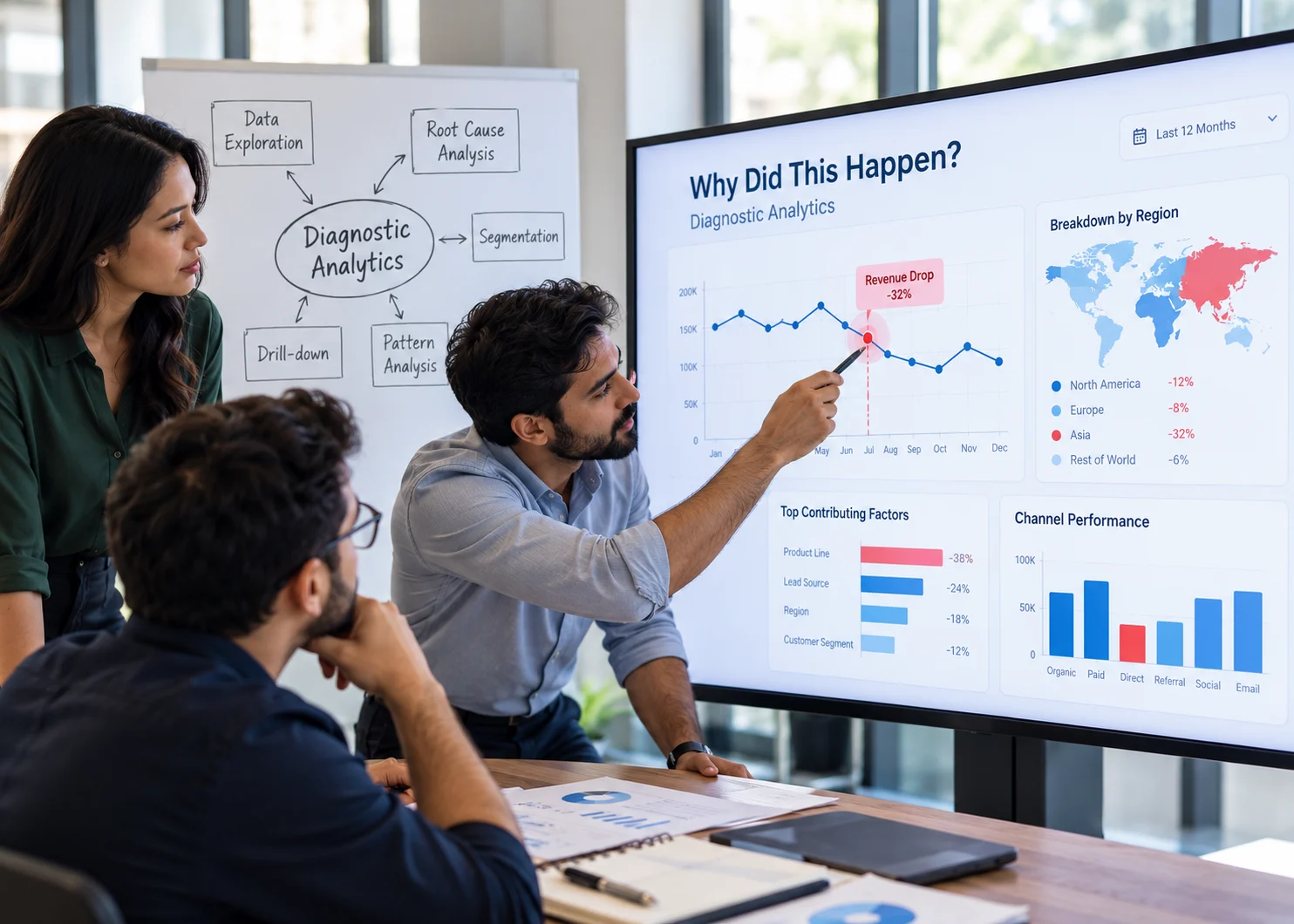
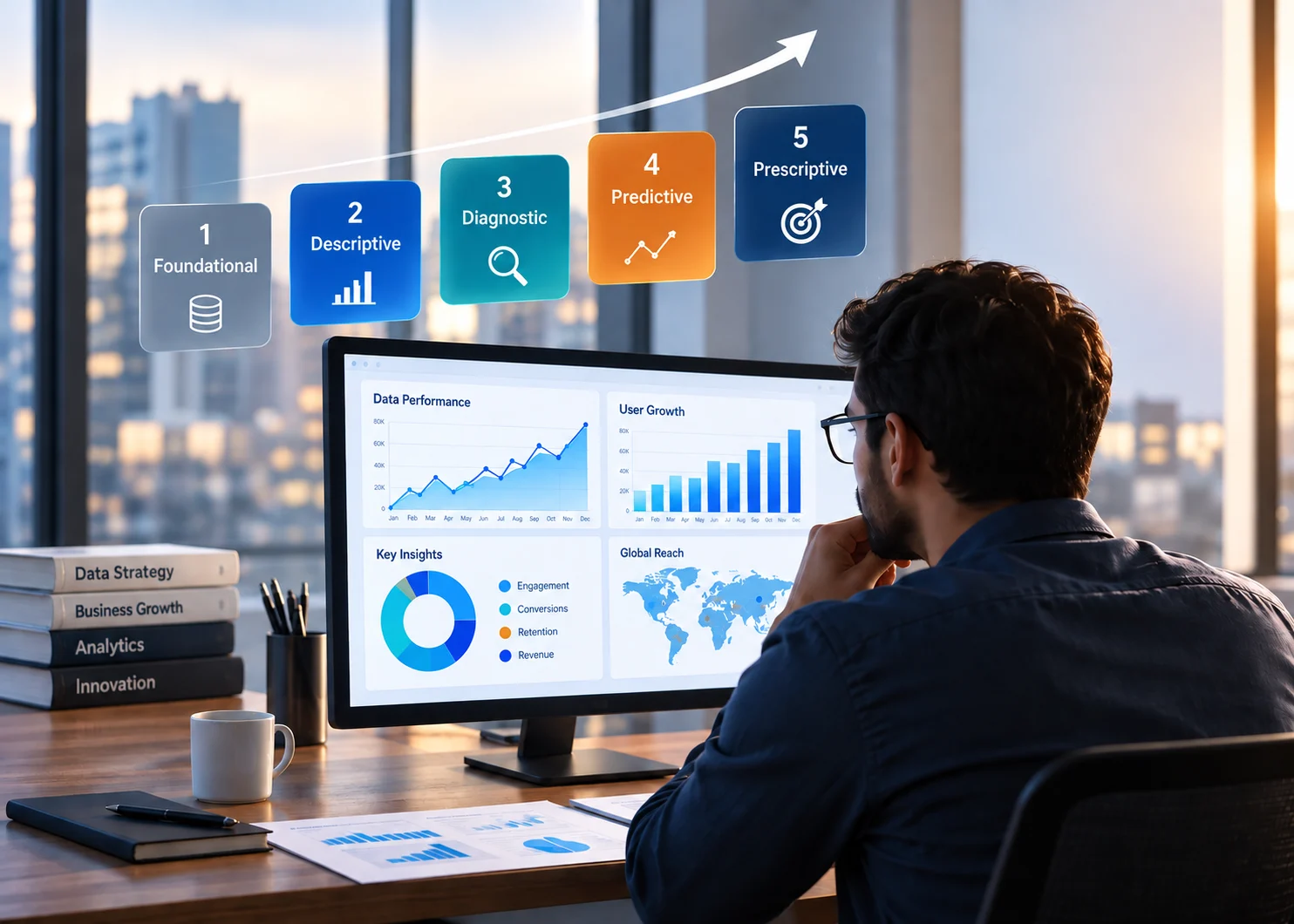
Descriptive analytics explains what happened. Diagnostic analytics explains why. Predictive analytics estimates what is likely next. Prescriptive analytics recommends what to do about it. Each stage builds on the one before, so a team with unreliable historical reporting should fix that first.
Benefits of Predictive Analytics Consulting
Better decisions, made earlier
A forecast that arrives before the quarter closes lets you change course while it still matters. Sales leaders can shift territory focus, and operations teams can adjust staffing before a spike.
Lower operational risk
Predictive maintenance shows the clearest published numbers. Deloitte Insights reports that it can raise equipment uptime by 10 to 20 percent, cut maintenance costs by 5 to 10 percent, and shorten maintenance planning time by 20 to 50 percent. You may see bigger figures in vendor material, such as a 70% reduction in breakdowns. Treat those with caution, because independent reviews trace them to weaker sources.
Stronger retention and revenue
Keeping customers pays off. Fred Reichheld of Bain & Company, writing with Earl Sasser in Harvard Business Review in 1990, reported that a 5% increase in customer retention can lift profits by 25% to 95%. That study is decades old and the range is wide, so use it as a signal of importance, not a promise. Churn models give you a way to find at-risk customers before they leave.
A faster start with less hiring risk
Hiring data scientists, data engineers, and an analytics lead takes time. A consulting team can deliver a first working model while you decide what to build in-house.
The limits
Predictive analytics is not magic. Keep these limits in mind:
- Data quality caps accuracy. Gartner estimates that poor data quality costs organizations an average of $12.9 million per year.
- Predictions are probabilities. A model that flags a customer as high risk is making an informed estimate, not stating a fact.
- Models decay. Customer behavior and markets change, so models need monitoring and retraining.
- People must act on the output. A churn score does nothing until someone owns the follow-up.
Predictive Analytics Solutions Consultants Build
Demand and sales forecasting
Time-series models estimate future volume using past sales, seasonality, promotions, and outside signals. Retailers use them for inventory, and service businesses use them for staffing.
Customer churn and lifetime value models
These models score each customer on their likelihood to leave or on the value they are likely to bring. Marketing and customer success teams then focus effort where it changes outcomes.
Lead and opportunity scoring inside your CRM
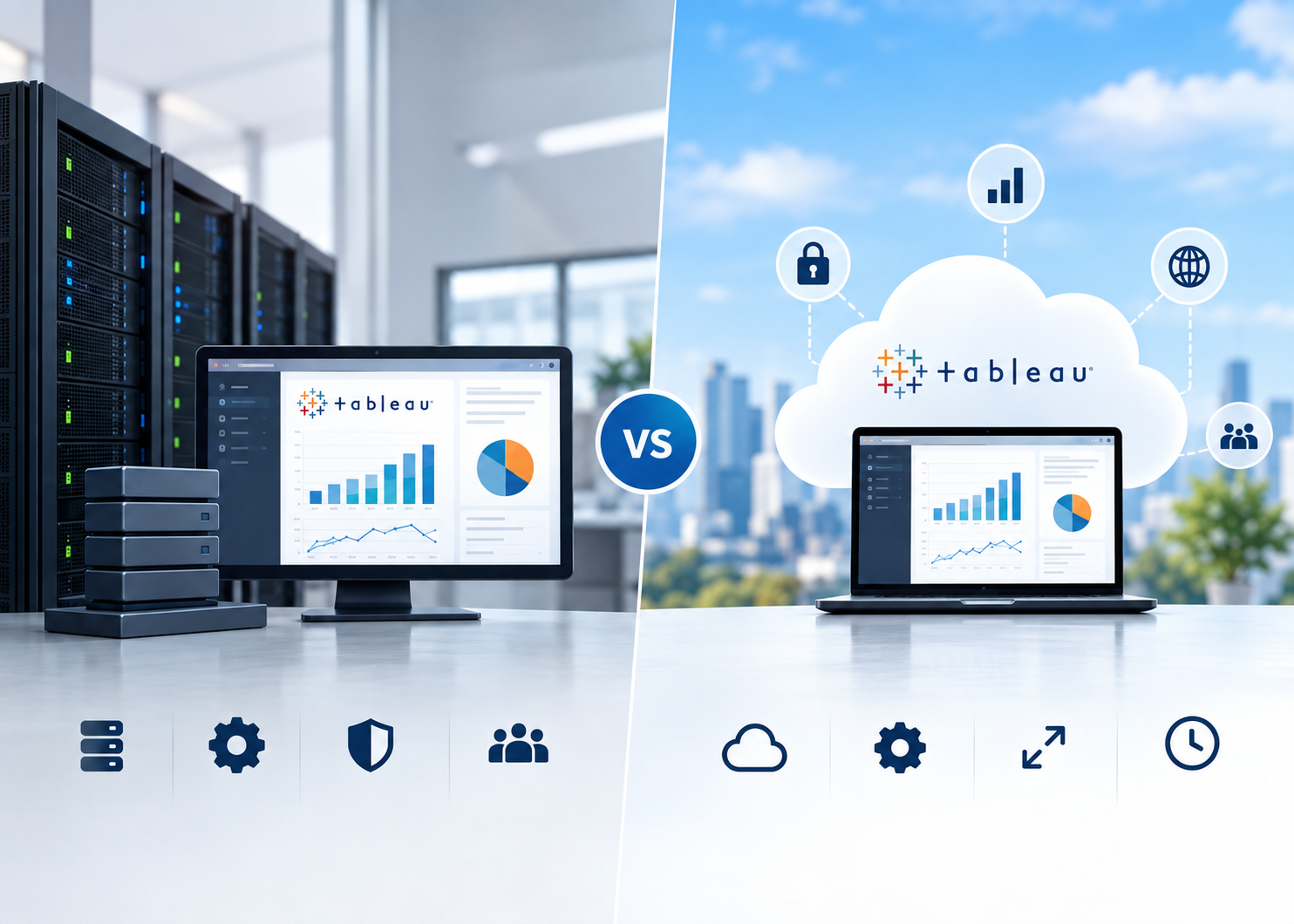
If your sales data lives in Salesforce, you can score deals where reps already work. Salesforce documents that Einstein Discovery builds models from CRM Analytics data and requires a CRM Analytics Plus or Einstein Predictions license, which carry an extra cost. Tableau’s help documentation adds that predictions can be embedded in dashboards and calculated fields. Teams that want help with this setup can look at Salesforce Einstein Discovery prediction services or broader Salesforce CRM analytics consulting. Licensing terms change, so confirm current requirements with Salesforce before you budget.
Anomaly and fraud detection
These models learn what normal looks like and flag transactions, logins, or sensor readings that fall outside it. Fraud and finance teams use them to prioritize reviews.
Predictive maintenance
Sensor and maintenance history feed models that estimate when equipment is likely to fail, so crews can fix it on a schedule instead of during an outage.
Dashboards that put predictions in front of decision makers
A strong model that no one sees has no impact. Good projects pair predictions with clear visuals, which is where data visualization services and Tableau consulting come in.
Machine learning layers for complex problems
Some problems need more than regression. Image data, text data, and very large feature sets often call for AI and machine learning services. A good consultant uses the simplest method that works.
Predictive Analytics Use Cases by Industry
These examples describe how organizations apply predictive methods. They are common patterns, not client results.
- Retail and e-commerce: demand forecasting, price testing, and next-best-product recommendations.
- Financial services: credit risk scoring, fraud detection, and collections prioritization.
- Manufacturing: predictive maintenance, quality defect prediction, and supply planning.
- Healthcare: patient volume forecasting, appointment no-show prediction, and resource planning.
- B2B software and services: churn prediction, pipeline forecasting, and expansion targeting.
- Logistics: route and delivery time estimation, and warehouse capacity planning.
How a Predictive Analytics Consulting Engagement Works
Most engagements follow the same arc, whatever the provider calls the phases.
- Define the decision and the metric. Pick one decision to improve and one number that proves improvement.
- Audit the data. Check availability, history, definitions, and ownership.
- Prepare the data. Clean records, join sources, and build the input features.
- Build and compare models. Test several approaches against a simple baseline.
- Validate. Score the model on data it has never seen and review errors with business owners.
- Deploy. Put predictions into the CRM, dashboard, or workflow where people make the decision.
- Monitor and retrain. Track accuracy and business impact, then update the model as data shifts.
A quick data readiness checklist
- You can name the outcome you want to predict and find past examples of it.
- You have enough history to cover seasons or business cycles.
- Key fields mean the same thing across teams and systems.
- Someone owns each major data source.
- You know which data you are allowed to use for modeling.
Advanced Considerations
Explainability
Business users trust predictions they can understand. Ask for models that show which factors drive a score, especially in lending, hiring, healthcare, and other sensitive areas.
Model drift
A model trained on last year’s customers may miss this year’s behavior. Agree on monitoring and retraining schedules before launch.
Governance and privacy
Document where data comes from, who can access it, and which fields stay out of models. Privacy rules differ by region and industry, so involve legal and compliance early.
Pairing predictions with AI agents
Some teams now connect prediction scores to AI agents that act on them, such as routing a high-risk account to a customer success manager. If that interests you, agentic AI services are worth exploring once your base models are reliable.
Measuring ROI honestly
Set a baseline before launch. Compare against a control group when you can, and count run costs, not only build costs. Report results as ranges until you have enough data to be sure.
How to Choose a Predictive Analytics Consulting Partner
What to look for
- Relevant experience with your industry, data sources, and platforms.
- Clear methods for validation, bias checks, and documentation.
- Willingness to explain models in plain language.
- A scoped discovery phase with defined deliverables.
- A plan for handing work over to your team.
Red flags
- Guaranteed accuracy or ROI figures before they have seen your data.
- No questions about how your team will use the predictions.
- Vague answers about monitoring after launch.
- Case studies with no named metrics or context.
Questions to ask before you sign
- Which business metric will this project move, and how will we measure it?
- What data do you need, and what happens if it is not good enough?
- How will you validate the model, and who reviews the errors?
- Who maintains the model after launch?
- What will we own at the end?
Consulting, staffing, or both
If you already have a roadmap and need capacity, you may not need a full consulting engagement. You can add skills through options like hiring a data analyst or hiring AI and machine learning developers.
Comparison Table: Choosing Your Delivery Model
| Delivery model | Speed to first result | Customization | Cost profile | Best fit | Best when you need | Main risk |
| Large consulting firm | Moderate | High | Highest, project-based | Enterprise programs with many stakeholders | Large-scale transformation, multiple teams, and complex analytics requirements | Cost and slower start |
| Boutique analytics specialist | Fast | High | Mid-range, scoped phases | Focused use cases, CRM or BI-centered work | Specialized expertise and faster implementation for specific analytics projects | Narrow platform focus |
| In-house team | Slow to build | Highest | Ongoing salaries and tools | Predictions at the core of the product | Long-term ownership, continuous development, and full control | Hiring and retention |
| Software-only platform | Fast | Low to moderate | License fees | Standard use cases with clean data | Quick deployment of common predictive analytics use cases with minimal consulting | Poor fit for unusual problems |
| Staff augmentation | Fast | Depends on your direction | Hourly or monthly rates | Teams with a clear roadmap but limited capacity | Additional technical expertise or capacity without building a full-time team | Needs strong internal leadership |
This table compares delivery models, not named agencies. Cost positions are relative and vary by project and region.
Frequently Asked Questions
Predictive analytics consulting services help organizations use historical data, statistics, and machine learning to forecast future outcomes. A consultant defines the business question, prepares data, builds and validates models, connects predictions to tools like CRM or dashboards, and trains your team to act on results. The goal is better decisions, not just more reports.
A predictive analytics consultant turns a business problem into a measurable prediction task. They audit your data, clean and engineer features, test several models, check accuracy against holdout data, and deploy the winner into daily workflows. After launch, they monitor performance, retrain models when data shifts, and document assumptions so your team can maintain the work.
Pricing varies widely, and no single public benchmark fits every project. Cost depends on data readiness, number of models, integration needs, team seniority, and whether you want ongoing support. Ask for a fixed-scope discovery phase first. It produces a defined roadmap and an estimate based on your actual data, which beats guessing from generic price ranges.
A focused first model, such as lead scoring or churn prediction, often takes weeks to a few months, depending on data quality and access. Larger programs with multiple models, integrations, and governance take longer. Data preparation usually consumes the biggest share of the timeline, so strong data readiness shortens delivery more than any modeling shortcut.
You need historical records that include the outcome you want to predict, such as closed deals, cancellations, or equipment failures. Add the inputs that might explain it, like customer activity, transactions, or sensor readings. Consistent definitions, enough history, and clear ownership matter more than volume. Consultants can assess readiness during an initial data audit.
Any industry with historical data and repeatable decisions can benefit. Retail and e-commerce use demand forecasting, financial services use risk and fraud models, manufacturing uses predictive maintenance, healthcare uses capacity and risk planning, and B2B software and services use churn and pipeline forecasting. Fit depends on data quality and a clear decision to improve.
Predictive analytics is the goal: forecasting likely outcomes from data. Machine learning is one set of methods for reaching it. Many predictive projects use regression or time-series statistics rather than complex machine learning, and simpler models often prove easier to explain. A good consultant picks the method that fits your data and decision, not the trendiest one.
Set a baseline before launch, then compare outcomes after the model goes live. Track the business metric the prediction targets, such as churn rate, forecast error, or unplanned downtime, alongside project and run costs. Use a control group when possible, so you can separate the model’s effect from seasonality and other changes.
Hire a consultant when you need speed, specialist skills, or an objective data audit. Build in-house when predictions sit at the core of your product and you can retain data scientists long term. Many teams combine both: a consultant builds the first models and trains staff, then internal analysts take over maintenance and new use cases.
Look for proof of relevant work, clear data governance practices, and transparent methods. Ask how they validate models, handle drift, and explain predictions to non-technical teams. Check platform expertise that matches your stack, request references, and insist on a scoped discovery phase with defined deliverables before committing to a long engagement.
Conclusion
Predictive analytics consulting services pay off when you treat them as a business project, not a technology purchase. The strongest engagements start with one decision worth improving, one metric that proves the change, and data your team trusts. Everything else, from model choice to dashboards, follows from those three things.
The published evidence supports real gains in areas like maintenance planning and customer retention. It also shows the limits: poor data quality drains budgets, models drift as behavior changes, and predictions only create value when someone acts on them. A good consulting partner is honest about those limits, explains results in plain language, and leaves your team able to run the work after launch.
If you are planning your first project, begin small. Audit your data, pick a single use case such as churn, lead scoring, or demand forecasting, and measure results against a baseline before you expand. That path keeps costs controlled and gives you proof, not promises, to guide the next investment.