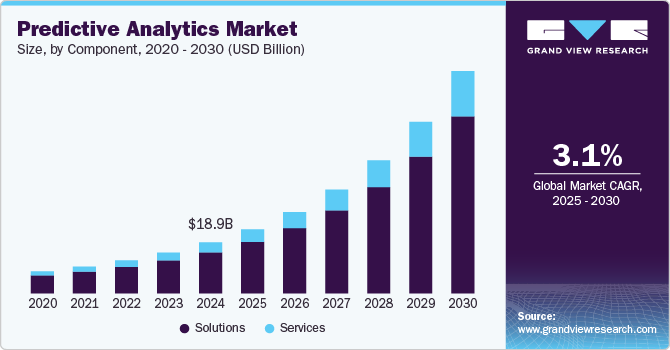
The global predictive analytics market is projected to grow from roughly $30.1 billion in 2026 to $82.3 billion by 2030, a compound annual growth rate of 28.3%, according to Grand View Research. Prescriptive analytics is climbing on a similar trajectory, expected to rise from $13.43 billion in 2026 to $34.41 billion by 2030, per Research and Markets. Both numbers point to the same reality: businesses are done guessing, and they are investing heavily in tools that tell them what is coming next and what to do about it.
Most teams throw around predictive analytics vs prescriptive analytics like the two terms mean the same thing. They don’t. I have sat in enough CRM and Salesforce data reviews to see the confusion firsthand, one team builds a forecast and stops there, another jumps straight to automated recommendations without knowing what those recommendations are based on. This guide breaks down the difference between predictive and prescriptive analytics in plain language, walks through real examples, and shows how the two work together inside a modern analytics strategy.
What Is Predictive Analytics?
Predictive analytics answers one core question: what might happen next? It pulls historical data from CRM systems, transaction logs, or customer interactions, then applies statistical models and predictive modeling techniques to spot patterns humans would miss on their own.
A predictive model does not guarantee an outcome. It produces a probability. A retail brand might use data forecasting to estimate that demand for a product line will rise 18% next quarter based on the last three years of seasonal data. A bank might apply risk prediction models to flag which loan applicants carry a higher chance of default. Neither example tells the business exactly what to do, both simply forecast what is coming.
Inside Salesforce, this shows up as Einstein Lead Scoring and Einstein Opportunity Insights, where the system reviews historical deal data and scores which leads are most likely to convert. Sales teams use these probability models to prioritize their day instead of working every account with equal effort. Businesses exploring this kind of business forecasting on their own CRM data can look at how Salesforce Einstein Discovery and Predictions apply these same techniques to pipeline and revenue data.
What Is Prescriptive Analytics?
Prescriptive analytics goes further than forecasting. It answers a different question: given what’s likely to happen, what should we actually do? It combines the outputs of predictive models with optimization algorithms, simulation, and decision optimization techniques to generate recommended actions, not just probabilities.
Where predictive analytics might tell a bank there’s a 70% chance a transaction is fraudulent, prescriptive analytics decides what to do with that number, freeze the transaction, flag the account, or trigger a customer verification step. Where predictive analytics forecasts a 20% chance a shipment will arrive late, prescriptive analytics recommends the specific carrier swap or route change most likely to avoid the delay.
Scenario analysis and what-if analysis sit at the center of this. A supply chain team can run a dozen possible demand scenarios and let a prescriptive model recommend which inventory allocation minimizes cost while meeting service targets. In a Salesforce environment, this can appear as next-best-action recommendations within the CRM, using AI and machine learning to turn predictions into specific steps that sales representatives can take.
Where Descriptive Analytics Fits Into Predictive vs Prescriptive Analytics
Predictive analytics vs prescriptive analytics is usually only half the picture. Most analytics maturity models actually start with descriptive analytics, which answers a simpler question first: what already happened? Descriptive analytics summarizes past performance through reports, dashboards, and historical trends, sales last quarter, website traffic last month, support tickets closed last week. It doesn’t forecast anything and it doesn’t recommend anything, it just tells you what already occurred.
The three sit on a curve. Descriptive analytics explains the past, predictive analytics estimates the future, and prescriptive analytics recommends the best response to that future. A business without solid descriptive reporting usually struggles to build reliable predictive models, since the historical data feeding the forecast is the same data descriptive analytics organizes in the first place. Skipping straight to prediction or prescription without that foundation is one of the more common reasons early analytics projects stall out.
Predictive Analytics vs Prescriptive Analytics: Key Differences
| Factor | Predictive Analytics | Prescriptive Analytics |
| Core question | What might happen? | What should we do about it? |
| Output | A forecast or probability | A specific recommended action |
| Techniques | Statistical analysis, machine learning, regression | Optimization algorithms, simulation, decision optimization |
| Data needed | Primarily historical data | Historical data plus real-time inputs |
| Business role | Anticipates outcomes | Guides the response to those outcomes |
| Complexity | Moderate | Higher, since it builds on predictive output |
The table captures the mechanics, but the real-world distinction comes down to this: predictive analytics narrows uncertainty, prescriptive analytics closes the loop between insight and action.
Terms to Know Before You Compare Predictive and Prescriptive Analytics
A quick glossary helps before going further, since a lot of the confusion around this topic comes down to overlapping vocabulary.
- Predictive model: An algorithm trained on historical data to estimate the probability of a future outcome.
- Prescriptive model: A model that evaluates possible actions and recommends the one most likely to produce the best outcome.
- Optimization algorithm: A method for finding the best possible solution among many options, often used inside prescriptive models.
- Machine learning: A set of techniques that let a model improve its predictions as it’s exposed to more data, without being explicitly reprogrammed.
- Scenario analysis: The practice of testing multiple possible future situations to see how each one would play out.
- What-if analysis: A narrower version of scenario analysis that tests the effect of changing one specific variable at a time.
- Historical data: Past records, transactions, or interactions used as the training foundation for predictive and prescriptive models alike.
Predictive Analytics vs Prescriptive Analytics Examples
A simple example makes the split concrete. Take a company trying to reduce customer churn. A predictive model looks at historical engagement, purchase behavior, and support interactions and estimates that a specific customer, call her Customer A, has a 78% probability of cancelling within the next 30 days. That’s the predictive layer, a risk score, nothing more. A prescriptive layer then takes that 78% and recommends what to do about it, scheduling a customer-success call, offering a personalized retention incentive, or flagging the account for extra support, based on what has worked for similar at-risk customers in the past. The prediction identifies the risk, the prescription tells the team how to respond to it.
That same pattern shows up across industries:
- Retail: Predictive analytics forecasts which products will spike in demand next month. Prescriptive analytics recommends exactly how much inventory to move to which stores to meet that demand without overstocking.
- Healthcare: Predictive models flag patients at higher risk of hospital readmission. Prescriptive models recommend specific follow-up care plans for each flagged patient.
- Financial services: Predictive analytics estimates the probability that a transaction is fraudulent. Prescriptive analytics decides whether to block the transaction, request additional verification, or let it pass.
- Sales and CRM: Predictive scoring ranks which leads are most likely to close. Prescriptive recommendations tell a rep which action, a call, a demo, or a discount, is most likely to move that specific deal forward.
- Manufacturing: Predictive maintenance models estimate when a machine is likely to fail. Prescriptive models recommend the exact maintenance window and parts needed to prevent that failure with minimal downtime.
Salesforce’s 2026 State of Sales report found the average seller spends only 40% of their time actually selling, with the rest going to admin work, data entry, and internal meetings. That gap is part of why pairing a predictive score with a prescriptive next step, rather than a score alone, matters so much for adoption. I’ve covered how that scoring layer plays out in practice in Salesforce Einstein Benefits for Business Growth in 2026, which looks at the predictive side of Einstein in more depth.
When to Use Predictive vs Prescriptive Analytics
Neither approach replaces the other, they solve different stages of the same problem.
Use predictive analytics when:
- You need early warning on risk, churn, or demand shifts
- Your team wants a forecast to plan budgets, staffing, or inventory
- You have solid historical data but limited real-time inputs
- The goal is understanding, not automated action
Use prescriptive analytics when:
- A predictive model already exists and needs an action layer on top of it
- Decisions need to happen at a speed or scale humans can’t manage manually
- You want to test multiple scenarios before committing resources
- The business needs a recommendation, not just a number
In practice, the two run as connected stages of one process rather than separate tools. A CRM model might predict that a particular lead has a high probability of converting this quarter. That prediction becomes the input for the prescriptive layer, which evaluates possible next steps and recommends the one most likely to close the deal, a demo invite, a pricing call, or a check-in from a manager. The flow looks like this:
Business Data → Predictive Model → Future Outcome → Prescriptive Model → Recommended Action → Measured Result
The last step matters as much as the first. Once a recommended action is carried out, the result becomes new data. Over time, a business can compare what the model predicted against what actually happened, see which recommendations worked, and refine both layers. A predictive model without a prescriptive layer leaves teams staring at a dashboard, unsure what to do next. A prescriptive model without solid predictive input is just a set of rules with no grounding in real patterns.
What the Data Needs to Look Like, and Where Projects Go Wrong
Getting predictive and prescriptive analytics right depends more on the data feeding the models than on the sophistication of the algorithm itself. A few things matter most.
What the models need:
- Historical data: Sales records, customer interactions, purchase history, or transaction records, typically at least a year or two of consistent history to capture seasonal and behavioral patterns.
- Real-time inputs for the prescriptive layer: Current stock levels, live pipeline activity, or recent transaction data, since a recommendation needs to reflect present conditions, not just the past.
- Relevant variables: Fields that actually relate to the outcome being predicted, a churn model needs purchase frequency and support history, not unrelated account details.
- Integrated data sources: CRM, ERP, and marketing systems connected well enough that a model can see a complete picture instead of a partial one.
Where projects tend to go wrong:
- Treating a predictive score as a decision. A 78% churn probability is a signal, not a verdict. Automating action directly off a raw score, without a prescriptive layer or human review, tends to produce more false positives than expected.
- Building prescriptive logic on top of an unproven prediction. If the underlying forecast is inaccurate or trained on messy, duplicated, or outdated records, the recommendation built on top of it inherits the same blind spots.
- Over-automating high-stakes decisions. Denying credit, escalating fraud cases, or canceling contracts based purely on a model’s recommendation, with no human checkpoint, creates real business and compliance risk.
- Ignoring model drift. A model trained on last year’s behavior can quietly lose accuracy as customer behavior, market conditions, or product lines shift, which is why models need periodic retraining rather than a one-time setup.
Benefits of Predictive Analytics and Prescriptive Analytics for Business
Combining both approaches inside one business intelligence strategy tends to produce a few consistent results:
- Faster, more confident decision-making, since teams act on a forecast plus a recommendation instead of guesswork
- Better resource allocation, from inventory to staffing to marketing spend
- Reduced risk exposure, particularly in fraud detection and credit decisions
- Higher CRM adoption, since reps get a next step, not just a score
- Measurable ROI, since prescriptive actions can be tracked and tied back to outcomes
None of this requires an enormous rebuild of existing systems. Most organizations already have the historical CRM or transaction data needed to start, what’s usually missing is the modeling and the connective layer between prediction and action.
Putting Predictive and Prescriptive Analytics to Work in Your CRM
Getting from raw CRM data to a working predictive model, and then to prescriptive recommendations reps and managers actually use, takes more than turning on a feature. It takes clean data, the right model setup, and dashboards people will actually check. Getting there usually comes down to three pieces:
- Salesforce CRM Analytics Consulting to get historical CRM data structured and ready for modeling
- Salesforce Einstein Discovery and Predictions to build the predictive layer directly inside Salesforce
- Data Analytics Services and Tableau Consulting to turn model output into dashboards decision-makers will actually use
- AI and Machine Learning Services to build the optimization and recommendation layer that turns a forecast into a prescriptive action
For a broader look at how the predictive side alone reshapes enterprise decisions before the prescriptive layer even enters the picture, How Does Predictive Analytics Improve Decision-Making in Enterprises? walks through that first stage in more detail.
FAQs: Predictive Analytics vs Prescriptive Analytics
Predictive analytics forecasts what is likely to happen using historical data and statistical models, while prescriptive analytics recommends the specific action to take based on that forecast. Think of predictive analytics as the diagnosis and prescriptive analytics as the treatment plan. One tells a business where the risk or opportunity sits, the other tells the team exactly how to respond to it. Most mature analytics programs use both together rather than picking a single layer to invest in.
Predictive analytics comes first. Prescriptive analytics builds on predictive output, so a business generally needs a working predictive model before a prescriptive layer adds much value. Teams that try to jump straight to automated recommendations without a solid forecast underneath them usually end up with generic, rules-based suggestions instead of ones grounded in actual historical patterns. Building the predictive layer first also gives a business a chance to validate model accuracy before letting it drive automated decisions.
Technically yes, but the recommendations tend to be weaker without a predictive foundation, since there’s no forecast grounding the suggested action in actual patterns. In practice, this looks like a rules engine that says “if X happens, do Y” based on fixed logic rather than learned behavior. It can still add value in simple, well-understood scenarios, but it won’t adapt the way a model trained on real historical outcomes will, and it tends to break down as conditions change.
Retail, healthcare, financial services, manufacturing, and sales organizations using CRM platforms all see strong returns, since each deals with large volumes of historical data and time-sensitive decisions. Retail and manufacturing tend to lean heavily on the demand-forecasting and inventory side, while financial services and healthcare lean more on risk scoring and patient or fraud triage. Sales organizations sit somewhere in between, using predictive scoring to prioritize leads and prescriptive recommendations to guide the next action on each one.
Salesforce Einstein spans both. Features like Lead Scoring and Opportunity Insights are predictive, since they score the likelihood of an outcome, while next-best-action recommendations move into prescriptive territory by suggesting what a rep should do with that score. Einstein Discovery sits at the center of this, since it can be configured to surface a prediction alone or pair it with a recommended action depending on how the model is set up.
There’s no fixed number, but most models need at least a year or two of consistent historical data to identify reliable seasonal and behavioral patterns. Data quality tends to matter more than raw volume. A smaller, clean, well-labeled dataset usually produces a more reliable model than a large dataset full of gaps, duplicate records, or inconsistent fields, which is why data cleanup is often the first real step before any modeling begins.
Optimization algorithms, simulation software, and AI-driven recommendation engines are common, often layered on top of existing BI tools like Tableau or CRM platforms like Salesforce. Some businesses build custom optimization logic for specific problems, like inventory allocation or pricing, while others rely on built-in recommendation features inside their existing CRM or analytics platform rather than building something from scratch.
No. Prescriptive analytics recommends an action, but a person or team still decides whether to act on it, especially for higher-stakes decisions. Lower-stakes, high-volume decisions, like which email to send a customer, are often automated end to end, while higher-stakes decisions, like denying a loan or escalating a fraud case, typically keep a human in the loop to review the recommendation before it’s carried out.
Timelines vary based on data quality and scope, but a focused predictive model inside an existing CRM can often be scoped and built in a matter of weeks rather than months. Projects that start with messy or incomplete CRM data take longer, since data cleanup and field mapping usually happen before any model gets trained. A single use case, like lead scoring, moves faster than a broader rollout across multiple business functions at once.
A churn model predicts a 25% chance a different customer cancels next month. A prescriptive layer then recommends the specific retention offer most likely to keep that customer, based on what has worked for similar accounts in the past. If the model also knows that customer responds better to a service call than a discount code, the recommendation adjusts accordingly, which is the kind of personalization a predictive score alone can’t deliver on its own.
Conclusion
Predictive analytics vs prescriptive analytics isn’t really a competition, it’s a sequence. Predictive analytics narrows down what’s likely to happen, and prescriptive analytics tells a team what to do with that information. Businesses that treat them as one connected system, rather than picking one over the other, get forecasts that actually drive action instead of dashboards that sit unopened.
If your team has CRM or transaction data sitting idle and no clear path from forecast to action, that gap is exactly where a predictive-to-prescriptive analytics strategy pays off fastest. Book a free strategy call to see what that would look like with your own data.