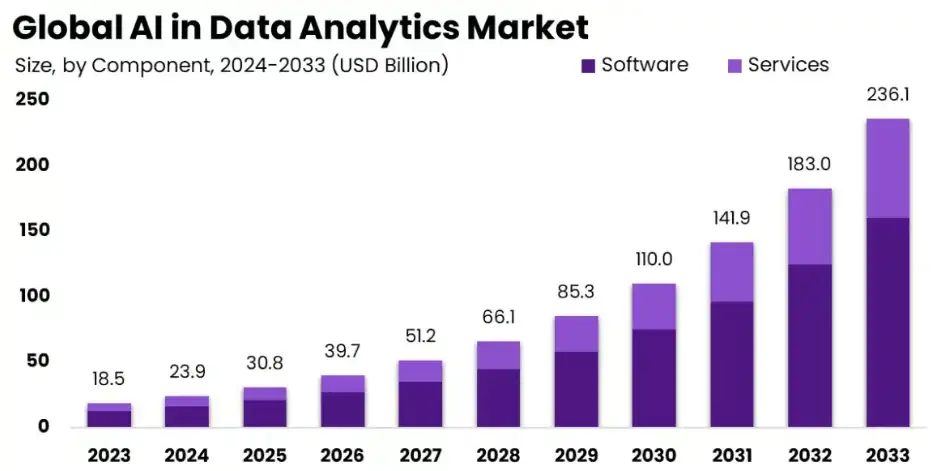
The global market for AI in modern data analytics is on track to grow from roughly $30.8 billion in 2025 to nearly $39.7 billion in 2026, and analysts expect it to reach $236.1 billion by 2033 at a 29% annual growth rate (Market.us). That jump in just one year tells you something important: businesses are no longer testing AI on the side. They are building it into the core of how they read data and make decisions.
Every dashboard, every report, and every customer insight now runs faster because of a layer of intelligence sitting underneath the raw numbers. This article breaks down what artificial intelligence in data analytics actually looks like in practice, why it matters more in 2026 than it did even two years ago, and how companies are using it to turn scattered data into decisions worth acting on.
What AI in Data Analytics Actually Means
AI-powered data analytics combines machine learning models, natural language processing, and automation with traditional analytics methods. Instead of a human analyst manually building every report, the system learns patterns from historical data and applies them to new data as it arrives.
Traditional analytics answered one question: what happened. Modern data analytics powered by AI answers four questions at once:
- Descriptive analytics: what happened
- Diagnostic analytics: why it happened
- Predictive analytics: Forecasts what is likely to happen next.
- Prescriptive analytics: what action to take about it
A retail chain, for instance, does not just see that sales dropped last week. Machine learning in data analytics can trace the drop to a specific region, flag the products involved, forecast how long the dip will last, and suggest a promotion to offset it. That full loop, from data to decision, is what separates old-style business intelligence from where the field stands today.
Why AI Has Become Central to Analytics in 2026
Data volume is the first driver. Roughly 2.5 million terabytes of data get created every day worldwide, and global data volume is expected to reach 221 zettabytes in 2026, a 22% jump from the year before (TechnoTrenz, 2026). No analyst team can review that manually. Big data analytics at this scale needs automated pattern recognition, which is exactly what machine learning provides.
Adoption numbers back this up. According to McKinsey’s State of AI 2026 survey of nearly 2,000 respondents across 105 countries, 88% of organizations now use AI in at least one business function, up from 78% a year earlier (McKinsey, 2026). Generative AI use has grown even faster, jumping from 33% of companies in 2024 to 72% in 2026. That growth is not confined to tech companies. Retail, healthcare, finance, and manufacturing are all folding AI for business analytics into daily operations.
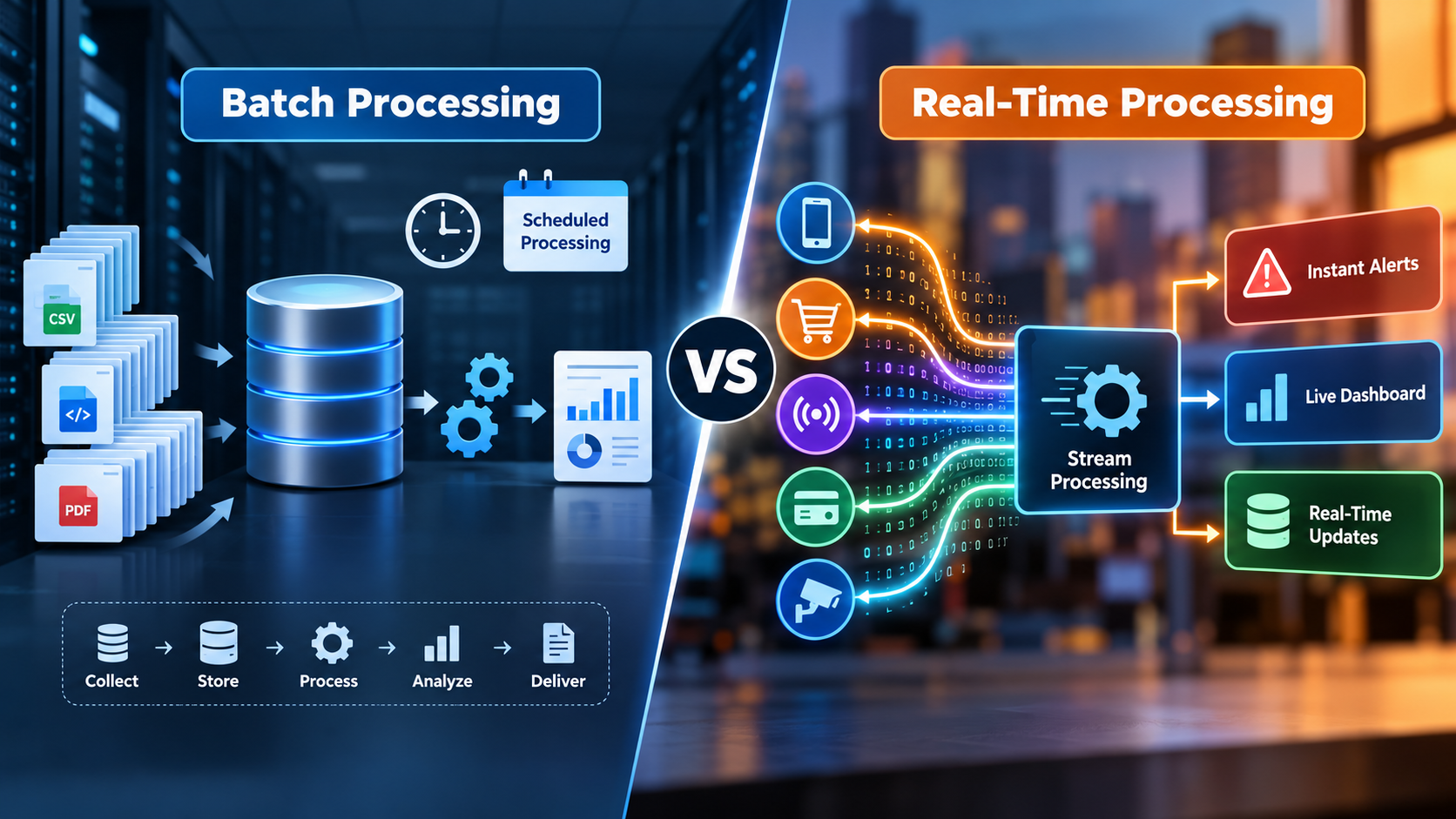
Cost and speed are the other two drivers. Cloud-based analytics platforms now handle deployments that used to take months in weeks, and 68% of enterprises already lean on analytics tools for day-to-day operational decisions, with 60% of new implementations running on cloud infrastructure (Business Research Insights, 2026). Once the infrastructure is cloud-native, adding an AI layer for real-time analytics or automated reporting becomes a configuration choice rather than a multi-year build. This is exactly the shift behind modern data analytics services, helping teams move from static, cloud-hosted dashboards to systems that learn and update on their own.
Core Applications of AI in Modern Data Analytics
Predictive and Prescriptive Analytics
Predictive analytics uses historical patterns to forecast outcomes like customer churn, demand spikes, or equipment failure. Prescriptive analytics goes one step further and recommends the specific action to take in response. A logistics company using this combination does not just predict a delivery delay; it reroutes the shipment automatically before the delay happens. If you want a deeper look at how this plays out in real enterprises, our breakdown of how predictive analytics improves decision-making in enterprises covers the mechanics in more detail.
Natural Language Processing and Automated Reporting
Natural language processing (NLP) lets business users ask questions in plain English and get answers pulled straight from the data, no SQL required. This is one of the biggest shifts in business intelligence dashboards over the last two years. Instead of waiting on an analyst to build a report, a sales manager can type “show me Q2 revenue by region” and get an answer in seconds through automated reporting tools built into most modern enterprise analytics platforms.
Anomaly Detection and Data Quality
Anomaly detection models scan transactions, sensor readings, or user behavior around the clock and flag anything that breaks the normal pattern, whether that is a fraudulent transaction or a machine part about to fail. This depends heavily on data quality, because a model trained on messy or incomplete data will flag the wrong things or miss real problems. Strong data governance and clean data engineering pipelines are what make anomaly detection reliable rather than noisy.
Customer Behavior Analysis and Recommendation Systems
Customer behavior analysis powered by AI is why product recommendations, personalized emails, and dynamic pricing feel so accurate now. Recommendation systems learn from browsing history, purchase patterns, and even time spent on a page to predict what a customer wants next. E-commerce has leaned into this hardest, with roughly 92% of leading online retailers now using AI-based personalization (TechnoTrenz, 2026).
KPI and Intelligent Dashboards
Intelligent dashboards do more than display numbers. They highlight the metrics that moved outside expected ranges, explain why in plain language, and suggest what to check next. This turns a static KPI dashboard into something closer to a analyst that never sleeps. For companies exploring this shift, our guide on building an AI analytics dashboard walks through the setup process step by step.
AI vs Traditional Data Analytics
The difference between AI vs traditional data analytics comes down to speed, scale, and how much a human has to touch each step.
| Factor | Traditional Analytics | AI-Driven Analytics |
| Data volume handled | Limited by manual review | Scales to millions of records automatically |
| Speed of insight | Days to weeks | Minutes to hours |
| Pattern detection | Relies on pre-set rules | Learns and adapts from new data |
| Output | Static reports | Predictions and recommended actions |
| Maintenance | Manual updates each cycle | Models retrain on new data automatically |
Traditional methods still matter. Structured data stored in clean, well-organized databases is often easier to analyze with straightforward statistical methods, and not every business question needs a machine learning model. The shift toward AI shows up most clearly when the data is unstructured data, such as support tickets, call transcripts, or social posts, where pattern recognition at scale genuinely outperforms manual review.
Real-World Examples of AI in Data Analytics
A regional bank using AI-driven analytics for fraud detection can review transaction patterns in real time and stop suspicious activity before funds move, instead of catching it days later during a manual audit. A manufacturer running operational analytics on sensor data can predict when a machine part will fail and schedule maintenance before a breakdown halts the line.
On the CRM side, businesses using Salesforce Einstein and similar tools combine data analytics with AI to score leads, predict which deals are likely to close, and prioritize outreach automatically. This is one of the areas where AI and business intelligence overlap most directly with day-to-day sales operations, and it connects closely to how Salesforce is used by data analysts inside CRM-heavy organizations.
Agentic systems are the newest layer here. According to McKinsey, 23% of organizations report they are already scaling an agentic AI system in at least one business function, and another 39% are experimenting with AI agents (McKinsey, 2026). In analytics specifically, this means agents that do not just report a problem but investigate it, pull related data, and draft a recommendation without waiting for a human to start the process. Our explainer on what agentic AI is and why businesses should care goes deeper into how this connects to analytics workflows.
Benefits of AI in Data Analytics
- Faster decision-making because insights arrive in near real time instead of after a weekly report cycle
- Higher accuracy in forecasting demand, churn, and risk compared with manual trend-spotting
- Ability to process both structured and unstructured data at scale
- Automated detection of anomalies and fraud before they cause damage
- Freed-up analyst time, since routine reporting gets automated and people focus on judgment calls instead
Challenges of AI in Data Analytics
The gap between adoption and impact is real. McKinsey’s 2026 State of Organizations report found that while 88% of companies are experimenting with AI, 81% report no meaningful bottom-line impact yet, and only 1% of US C-suite leaders describe their generative AI rollouts as mature (McKinsey, 2026). A few reasons show up repeatedly:
- Data quality problems: models trained on inconsistent or incomplete data produce unreliable predictions
- Integration difficulty: connecting AI tools with legacy systems and existing cloud analytics infrastructure takes real engineering work
- Skills gaps: teams need people who understand both the business question and the technical model behind it
- Trust and governance: 46% of leaders cite concerns about bias and IP risk as a top barrier to scaling AI, with regulatory concerns close behind at 44% (McKinsey, State of Organizations 2026)
None of these challenges are reasons to avoid AI-driven analytics. They are reasons to plan the rollout carefully, starting with clean data foundations and a clear business question rather than adopting a tool because it is trending.
Best Practices for AI-Driven Analytics
- Start with a specific business problem, not a general AI initiative. Fraud detection, demand forecasting, and churn prediction all have clear success metrics.
- Fix data quality and governance before scaling models. A model is only as good as what it learns from.
- Keep humans in the loop for high-stakes decisions, even as automation handles the routine ones.
- Measure impact against a real baseline, not against how “advanced” the tool sounds.
- Choose analytics platforms that fit your existing data infrastructure rather than forcing a rebuild.
Companies weighing whether to build this in-house or bring in outside expertise often start by comparing the cost involved. Our breakdown of what it costs to hire a data analytics consultant in 2026 lays out typical rates for exactly this kind of project.
The Future of AI in Data Analytics
Growth projections point to a market still in its early stage rather than its peak. The broader data analytics market is expected to climb from around $83.79 billion in 2026 to more than $785 billion by 2035, a 28.35% compound annual growth rate (Precedence Research, 2026). Within that, agentic systems, real-time anomaly detection, and NLP-driven reporting are the segments growing fastest, since they solve the exact pain points, speed and manual effort, that held analytics back for years.
The direction is clear even if the pace varies by industry: analytics is shifting from something a team produces once a week to something that runs continuously in the background, flags what matters, and increasingly suggests what to do about it.
FAQs
AI adds pattern recognition, prediction, and automation on top of traditional analytics, so businesses get forecasts and recommended actions instead of just historical reports. Rather than waiting for an analyst to compile a weekly summary, teams get a continuous stream of insight that updates as new data comes in, which shortens the time between spotting a problem and acting on it.
Traditional analytics tells you what already happened. AI-driven analytics adds why it happened, what is likely to happen next, and what action to take, often in real time. The underlying data collection process may look similar, but the output changes from a static report a person has to interpret to a set of predictions and suggestions the system generates on its own.
Retail, finance, healthcare, manufacturing, and logistics see the biggest gains, mainly through fraud detection, demand forecasting, predictive maintenance, and personalization. Each of these industries generates high volumes of transactional or sensor data, which is exactly the kind of dataset machine learning models are best suited to learn from and act on quickly.
Machine learning is one part of AI. It is the technique that lets systems learn from historical data, while AI in analytics also includes NLP, automation, and anomaly detection working together. In practice, most analytics platforms blend several of these techniques at once rather than relying on a single model to handle every task.
Poor data quality, integration with legacy systems, skills gaps, and unclear governance are the most common barriers, according to McKinsey’s 2026 research on enterprise AI adoption. Many companies also underestimate how much cleanup their existing data needs before a model can produce dependable results, which is often the real reason early pilots stall out.
Yes. Cloud-based analytics platforms have lowered the cost of entry significantly, so small and mid-sized companies can access many of the same predictive tools that used to require large data teams. Most providers now offer usage-based pricing, which means a smaller company can start with one specific use case, like churn prediction, before expanding further.
Prescriptive analytics recommends a specific next action based on predicted outcomes. AI powers this by combining prediction models with rules or optimization logic that suggest the best response, so instead of just flagging that a delivery might be late, the system can propose an alternate route or supplier automatically.
AI models process incoming data continuously instead of in scheduled batches, so anomalies, fraud, or demand shifts get flagged within minutes rather than during the next reporting cycle. This matters most in situations where a delay of even a few hours, like a fraudulent transaction or a supply chain disruption, can turn into a much bigger cost.
Consistency, completeness, and accurate labeling matter most. Models trained on messy or biased data will produce unreliable predictions no matter how advanced the algorithm is, which is why most successful AI analytics rollouts spend as much time on data governance and cleanup as they do on choosing the model itself.
Expect more agentic systems that investigate problems on their own, wider use of natural language queries for reporting, and analytics that runs continuously rather than on a weekly or monthly cycle. Over the next few years, the bigger shift may be less about new algorithms and more about how deeply these systems get embedded into everyday business workflows.
Conclusion
AI in modern data analytics has moved past the experimentation phase for most industries, even if the return on investment still lags the hype in plenty of organizations. The businesses seeing real results are not the ones chasing every new tool. They are the ones that fixed their data quality first, picked one clear problem to solve, and let AI-driven analytics handle the parts that used to eat up an analyst’s whole week: forecasting, anomaly detection, and reporting.
The market data backs this up. Growth in this space is not slowing down, and the gap between companies using AI well and companies still stuck on static reports will only get wider over the next few years. Getting the fundamentals right now, clean data, a clear use case, and the right platform, matters more than getting in early.