Sales teams are stretched thinner than ever, and the numbers prove it. According to Salesforce’s own State of Sales report, 94% of sales leaders who use AI agents now call them critical to meeting business demands, and 87% of sales organizations already run some form of AI inside their CRM. That is not a future trend. That is the current baseline for any company trying to compete in 2026.
This shift is exactly why Salesforce Einstein benefits have become one of the most searched topics among sales, service, and marketing leaders this year. Einstein has moved past simple lead scoring into forecasting, generative content, and autonomous agents that act on customer data without waiting for a human to click a button. Below is a practical, no-fluff breakdown of what Einstein actually does, the real numbers behind it, and how businesses are using it to grow revenue instead of just adding another dashboard.
What Is Salesforce Einstein, Really?
Salesforce Einstein AI is not one single tool. It is an umbrella of AI capabilities built directly into the Salesforce platform, covering predictive models, generative content tools, and conversational agents. Salesforce introduced Einstein in 2016 as a predictive layer for lead scoring and opportunity insights, then expanded it with generative features (Einstein GPT) and, more recently, agentic capabilities through Agentforce.
Three categories make up the core of Salesforce Einstein features today:
- Predictive AI – Uses machine learning on historical CRM data to forecast outcomes like deal closure probability, churn risk, and inventory needs.
- Generative AI – Drafts emails, case replies, call summaries, and content using natural language prompts, pulling directly from CRM records for context.
- Agentic AI (Agentforce) – Autonomous agents that reason through multi-step tasks, such as resolving a support case or updating a billing address, without a rep manually handling each step.
This combination is what makes Einstein different from a bolt-on chatbot. Everything runs on the same unified customer data model, so the AI has full context instead of guessing from a single interaction.
Salesforce Einstein Benefits for Business Growth
1. Sales Teams Get Hours Back Every Week
Manual data entry has always been the quiet productivity killer in CRM. Einstein’s activity capture automatically logs calls, emails, and meeting notes by connecting to a rep’s email and calendar, so records stay current without anyone typing a single field manually. Salesforce’s 2026 sales research found reps save close to 12 hours a week once AI tools are fully adopted, with prospect research time dropping by 34% and email drafting time falling by 36%.
That time saving is one of the clearest long-tail benefits of Salesforce Einstein: less admin work translates directly into more selling hours, which is the whole point of AI in Salesforce for business growth.
2. Predictive Analytics Improves Forecasting Accuracy
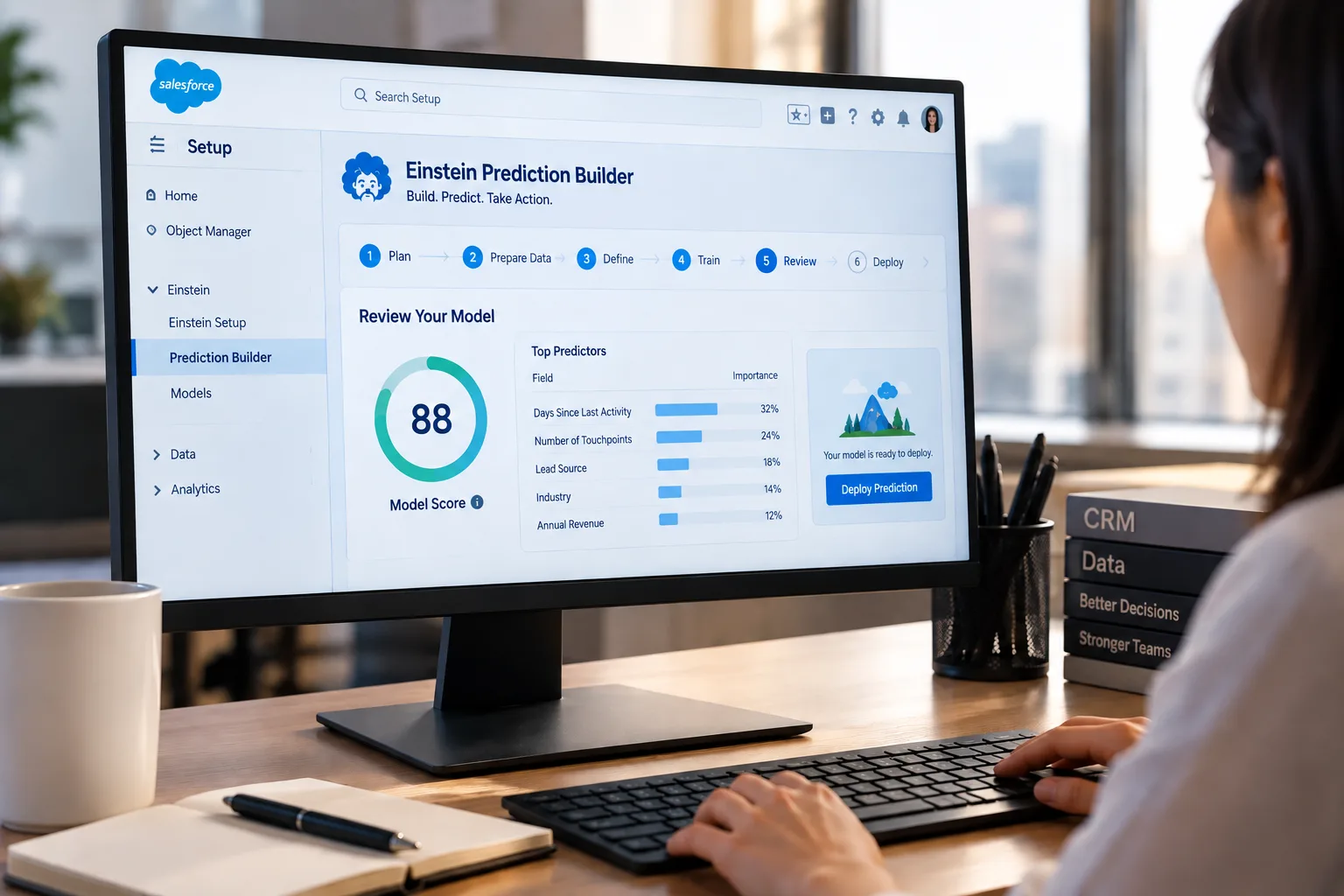
Predictive analytics is where Einstein started, and it remains one of its strongest use cases. Einstein Lead and Opportunity Scoring reviews historical deal data, engagement patterns, and customer behavior to assign a probability score to each open opportunity. Sales managers can then prioritize the deals most likely to close instead of splitting attention evenly across a pipeline.
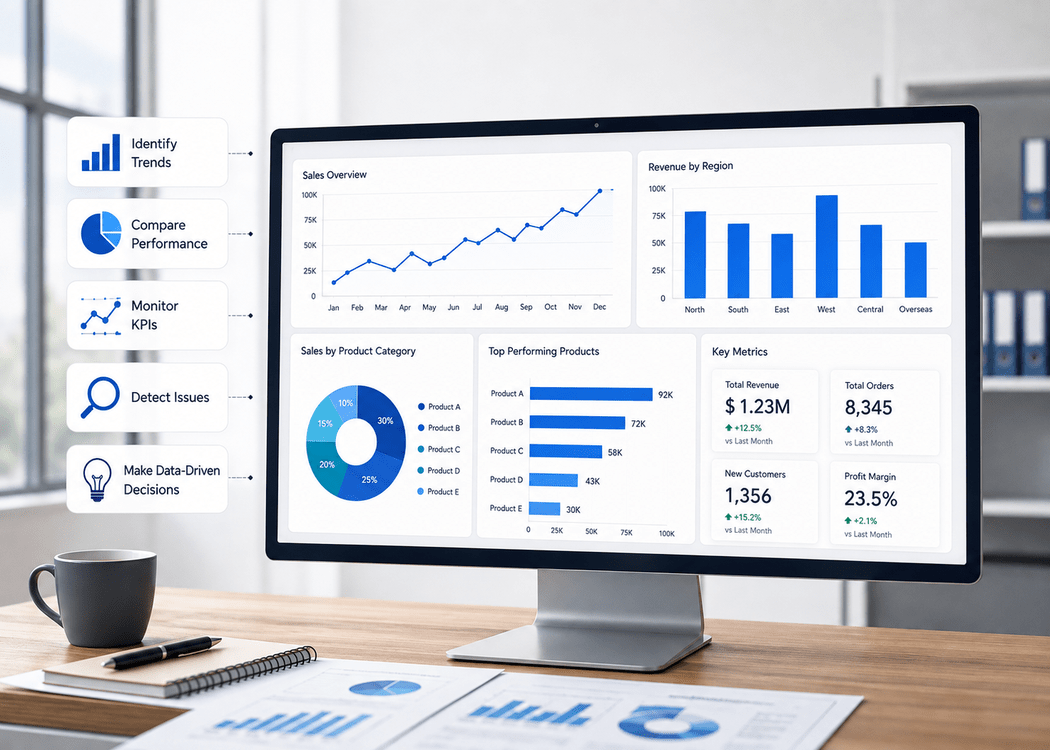
This is a direct driver of sales forecasting accuracy and revenue optimization, since resource allocation decisions get made on data instead of gut feeling. Combined with CRM analytics dashboards, teams get a real-time view of pipeline health rather than a static end-of-quarter report.
If your team is weighing how deep to go with this, our Salesforce CRM Analytics Consulting Services walk through which predictive models are worth configuring first based on your existing data quality.
3. Generative AI Cuts Content Creation Time
Einstein GPT generates sales emails, case responses, contract clauses, and account summaries using CRM data as context, so the output reflects the actual account history instead of a generic template. A sales rep preparing for a renewal call can get a summary of recent activity, open risks, and next steps in the side panel of the opportunity record, cutting meeting prep from twenty minutes to two.
This is where Salesforce Einstein capabilities move from “nice to have” to a measurable business automation tool, since the same generative layer also drafts marketing copy, service replies, and internal reports.
4. Customer Service Gets Faster Without Losing Quality
On the service side, Einstein’s Case Classification and Reply Recommendations automatically route incoming cases and suggest context-aware responses. Salesforce’s own benchmarks show this kind of automation deflecting around 30% of routine support tickets through self-service, and the company has stated it expects AI to help resolve as much as half of all service cases by 2027, up from roughly 30% in 2025.
That is a meaningful chunk of customer engagement work handled without adding headcount, which is exactly the kind of AI-powered CRM efficiency businesses are chasing heading into next year.
5. Agentforce Extends Einstein Into Autonomous Action
Where Einstein used to stop at “here’s a suggestion,” Agentforce takes it a step further by acting on the customer’s actual goal. If a customer wants to renew a subscription and update a billing address in the same request, Agentforce can reason through both steps and complete them without a human touching a single screen. Salesforce reported that Agentforce closed thousands of deals within its first 90 days of general availability and has since handled millions of customer conversations across its install base.
For businesses exploring how far this can go, our Agentic AI Services cover the practical side of scoping which workflows are ready for autonomous agents and which still need a human in the loop.
6. Better Data Discipline, Better AI Output
None of the above works without clean, connected data. Salesforce’s research also found that over half of sales leaders using AI say disconnected systems slow down their AI initiatives, and a large share of sales professionals are actively investing time in data cleansing to fix it. This is the part most companies underestimate: Einstein’s predictions and Agentforce’s autonomy are only as strong as the CRM data feeding them.
This is why a real AI CRM implementation strategy matters more than simply switching a feature on. Our AI and Machine Learning Services and Data Analytics Services both start with a data audit before any Einstein feature gets configured, because a messy data foundation quietly kills forecasting accuracy no matter how good the model is.
Salesforce Einstein Use Cases Across Departments
- Sales – Lead scoring, opportunity insights, forecasting, automated email drafts, and account summaries.
- Service – Case classification, reply recommendations, knowledge article suggestions, and bot-driven self-service.
- Marketing – Natural-language audience segmentation, AI-generated campaign briefs, and send-time optimization.
- Operations and Field Teams – Inventory summaries, route insights, and account health scoring for supervisors managing multiple territories.
Across every one of these, the common thread is data-driven decision making replacing manual review. Reps and managers spend less time compiling reports and more time acting on what the reports already say.
Salesforce Einstein ROI: What the Numbers Actually Show
Businesses considering the investment usually want a straight answer on return. Based on Salesforce’s published research and independent industry benchmarks:
- Reps save close to 12 hours weekly on average once AI tools are fully adopted.
- Prospect research time drops by roughly a third, and email drafting time drops by more than a third.
- Around 30% of routine support tickets get deflected through self-service AI tools, with that figure trending toward 50% by 2027.
- 54% of individual sales reps have already used an AI agent in their workflow, and nearly nine in ten plan to by 2027.
These are not vendor marketing claims pulled from a slide deck. They come from a double-anonymous survey of over 4,000 sales professionals that Salesforce ran in late 2025, which gives the figures more weight than a typical case study.
Getting Started Without Overcomplicating It
The businesses that get the most out of Einstein usually start small. Enabling basic predictive scoring or activity capture can happen within hours on the right edition, while a full Agentforce deployment for a complex workflow typically takes a few weeks to plan, build, and test properly. Trying to launch every feature at once is the fastest way to end up with AI outputs nobody trusts.
A simpler path looks like this:
- Audit existing CRM data quality before enabling anything.
- Turn on one predictive feature, like opportunity scoring, and measure the impact for a full sales cycle.
- Add generative tools for the highest-volume task, whether that is email drafting or case replies.
- Only move to autonomous agents once the underlying data and workflows are proven stable.
If mapping that sequence for your specific Salesforce org feels like a lot, our Salesforce Einstein Services team handles exactly this kind of phased rollout, so features get enabled in an order that actually compounds rather than creating noise.
Frequently Asked Questions
Small businesses get faster lead scoring, automated email drafts, and case deflection without needing a dedicated data science team, since Einstein’s low-code tools handle configuration through point-and-click setup rather than custom development.
Einstein reviews historical deal data, past close rates, and engagement signals to predict which open opportunities are most likely to close, giving sales managers a probability-based view instead of relying on rep-reported pipeline stages alone.
No. Einstein is the broader AI layer covering predictive, generative, and conversational capabilities, while Agentforce is the agentic platform built on top of it that lets those capabilities act autonomously across multi-step workflows.
It automates case classification, suggests knowledge articles, drafts reply content, and powers self-service bots, which together deflect a meaningful share of routine support tickets before they ever reach a human agent.
Basic features like activity capture and lead scoring can be enabled through standard setup menus. More advanced custom models may benefit from a consulting partner, but day-one adoption does not require in-house data scientists.
Pricing varies by edition and feature. Many core Einstein AI capabilities are included in Enterprise-tier and above editions, while Agentforce follows its own consumption or subscription-based pricing depending on usage volume.
It needs consistently logged CRM data, including activity history, contact details, and deal stages. Gaps or duplicate records directly reduce prediction accuracy, which is why data cleansing is usually the first implementation step.
Yes. Activity capture connects to common email and calendar providers to automatically log interactions, keeping CRM records updated without manual entry from reps.
Predictive AI forecasts outcomes, such as which lead is most likely to convert, based on historical patterns. Generative AI creates new content, like a draft email or case reply, using CRM context as the input.
Basic predictive features can show measurable impact within a single sales cycle, often 30 to 90 days, while more complex agentic workflows may take longer to fully stabilize and demonstrate consistent ROI.
Final Thought
Salesforce Einstein has evolved from a predictive analytics tool into a comprehensive AI platform that helps businesses work smarter across sales, service, marketing, and operations. Whether it’s reducing manual work, improving forecasting accuracy, generating personalized content, or enabling autonomous workflows with Agentforce, Einstein gives organizations practical ways to increase productivity and deliver better customer experiences.
The biggest gains, however, come from a thoughtful implementation strategy. Businesses that start with clean CRM data, roll out AI features in phases, and measure results along the way are far more likely to see meaningful ROI than those trying to enable everything at once. As AI continues to reshape customer relationship management in 2026 and beyond, Salesforce Einstein offers a scalable foundation for businesses looking to drive sustainable growth, improve operational efficiency, and stay ahead in an increasingly competitive market.