Salesforce’s State of Data and Analytics report found that 54% of business leaders are not totally confident the data they need is accessible, even with more data at their fingertips than ever. Access is only half the problem. Leaders also need to know where a number came from. When a dashboard shows a figure nobody can explain, three teams can lose a week finding out why.
Data lineage ends those hunts. This guide explains what data lineage is, how it works, which types exist, why it matters for governance and AI, and how to start. It is written for founders, marketing leaders, and analytics teams who want a plain answer first and deeper detail after.
What Is Lineage?
Lineage means ancestry. A family tree shows who came from whom. A museum record shows who owned a painting and when it changed hands. In both cases, lineage answers one question: where did this come from, and what happened along the way?
Data follows the same logic. Every figure in a report has ancestors: the system that first captured it, the jobs that cleaned it, and the formulas that reshaped it. Without a record of that ancestry, you can only trust a number on faith.
What Is Data Lineage?
Data lineage is a documented, traceable record of where data originates, how it changes as it moves through systems, and where it ends up. Think of it as a map for your data flow. A good map lets you start at any report and walk backward to the source, or start at any source and walk forward to every report it feeds.
The Core Parts of Data Lineage
Most lineage maps contain the same building blocks:
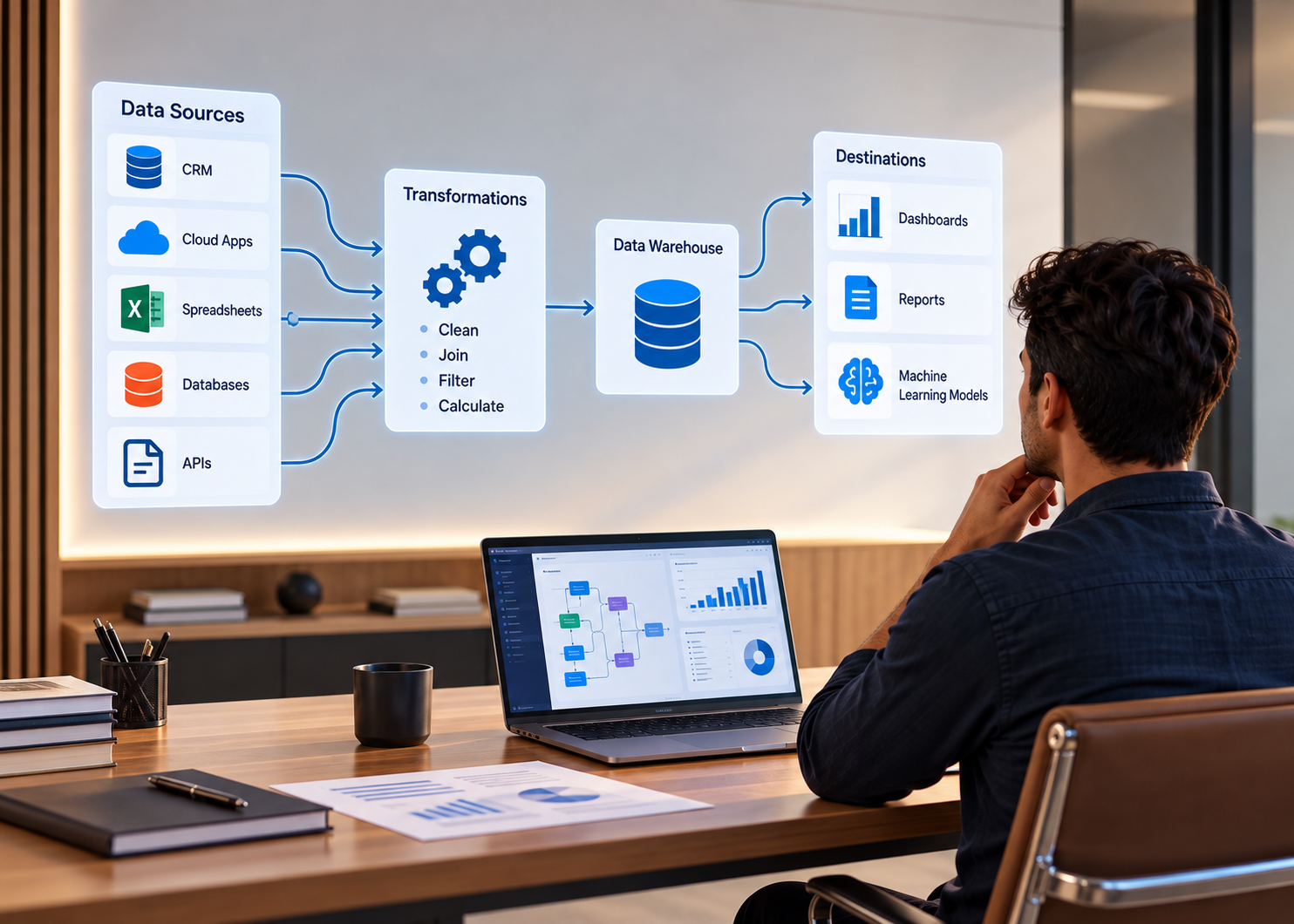
- Sources: the places data starts, such as a CRM, a web form, an app database, or a spreadsheet upload.
- Transformations: the steps that clean, join, filter, or calculate, including SQL models and ETL or ELT jobs.
- Destinations: the tables, dashboards, reports, and machine learning models that consume the result.
- Metadata: the descriptive details around each step, such as owner, schema, run time, and definition.
Upstream and Downstream Lineage
Upstream lineage traces data back toward its sources. You use it when a number looks wrong and you need the cause. Downstream lineage follows data forward to everything that depends on it. You use it before a change, to see what might break.
A Simple Example
Imagine a company whose sales dashboard reports $480,000 in revenue, while its finance report shows $452,000 for the same period. Both teams believe their numbers are correct, but neither can immediately explain the difference.
Data lineage helps the team trace both figures through their data pipelines. The sales dashboard may use CRM order records processed in a data warehouse, while the finance report applies additional rules to exclude canceled orders or account for adjustments. By examining the transformations and metric definitions, the team can identify where the two reporting paths differ.
This example illustrates why data lineage matters beyond documenting data movement. It helps teams distinguish between an actual data error and a disagreement in how a metric is calculated. Once the underlying definition is clarified, the company can align its reports and prevent the same confusion from recurring.
What Is Data Lineage in Data Governance?
Data governance sets the rules for how an organization defines, protects, and uses data. Data lineage gives those rules evidence. A policy that says only approved definitions feed executive reports means little until you can prove which sources feed each report.
In practice, lineage supports governance in four ways:
- Ownership: each dataset and transformation shows a named owner or steward.
- Policy enforcement: teams see where sensitive fields travel and whether controls follow them.
- Audit readiness: reviewers get a documented path from a reported figure to its source.
- Definition control: analysts confirm that the approved metric definition reaches every downstream report.
Lineage also strengthens data quality management. When a quality check fails, lineage shows the failing step and every report it affects, so teams fix the cause once instead of patching symptoms.
Regulatory Context
Several rules reward teams that can trace their data:
- GDPR: Article 30 requires controllers to keep records of processing activities. Lineage helps teams see which systems hold personal data, which also supports access and erasure requests.
- BCBS 239: The Basel Committee published these principles in 2013 for risk data aggregation and risk reporting at banks. Traceable data sources help banks show how reported risk figures were built.
Lineage does not make a company compliant on its own. It supplies the traceability that compliance work depends on.
Why Is Data Lineage Important?
The value of data lineage shows up the moment something goes wrong or something needs to change.
Trust in Reports
People trust numbers they can trace. When a leader questions a dashboard, an analyst can show the path from source to chart instead of arguing about whose spreadsheet is right.
Faster Root Cause Analysis
Without lineage, debugging a bad metric means asking around. With lineage, you follow the upstream path until you find the step that broke. That turns a multi-day search into a focused check.
Impact Analysis Before Changes
Before you rename a column, retire a table, or change a pipeline, downstream lineage shows every report, model, and team that depends on it. You warn the right people first and avoid surprise outages.
Privacy and Audit Support
When a customer asks what data you hold about them, lineage helps you find every system that stores it. When an auditor asks how a figure was built, lineage gives you the documented path.
Safer Migrations
Moving to a new warehouse or cloud platform is risky when nobody knows what depends on what. A lineage map shows which pipelines to move together and which to retire.
Grounded AI Outputs
Models learn from the data you feed them. Lineage shows which sources trained a model, which makes it easier to investigate odd outputs and to explain model behavior to reviewers.
Who Benefits From Data Lineage?
Different teams use the same map for different jobs:
- Marketing leaders confirm that campaign and attribution numbers match the CRM.
- Finance teams document how reported figures were calculated.
- Data engineers debug pipelines faster and plan changes safely.
- Compliance and legal teams locate personal data and prepare for audits.
- Executives gain confidence that decisions rest on traceable numbers.
Types of Data Lineage
No single type fits every need. Most teams combine several, because each answers a different question. The types fall into four groups.
Business, Technical, and Operational Lineage
- Business lineage shows data in plain terms: which business concepts, owners, and reports connect. Analysts and executives use it.
- Technical lineage shows the actual tables, columns, jobs, and code. Engineers use it.
- Operational lineage shows what happened at run time: which jobs ran, when, and whether they succeeded.
Table-Level and Column-Level Lineage
Table-level lineage shows which tables feed which tables. It is simpler to build and good for a first pass.
Column-level lineage shows which individual fields feed a metric and which calculations change them. It takes more effort, but it answers sharper questions, such as where one sensitive field travels or which source columns drive revenue.
Forward, Backward, and End-to-End Lineage
- Backward lineage traces a result to its sources.
- Forward lineage traces a source to its consumers.
- End-to-end lineage connects both directions across the full path, from original source to final report.
Manual, Pattern-Based, and Automated Lineage
- Manual lineage relies on people documenting flows in spreadsheets or diagrams. It works for small environments but goes stale quickly.
- Pattern-based lineage infers connections by comparing data values and naming patterns. It can miss logic hidden in code.
- Automated lineage reads metadata, parses queries, and captures job events to build the map for you. It scales best and needs careful setup.
How Data Lineage Works
Automated tools collect lineage in three common ways.
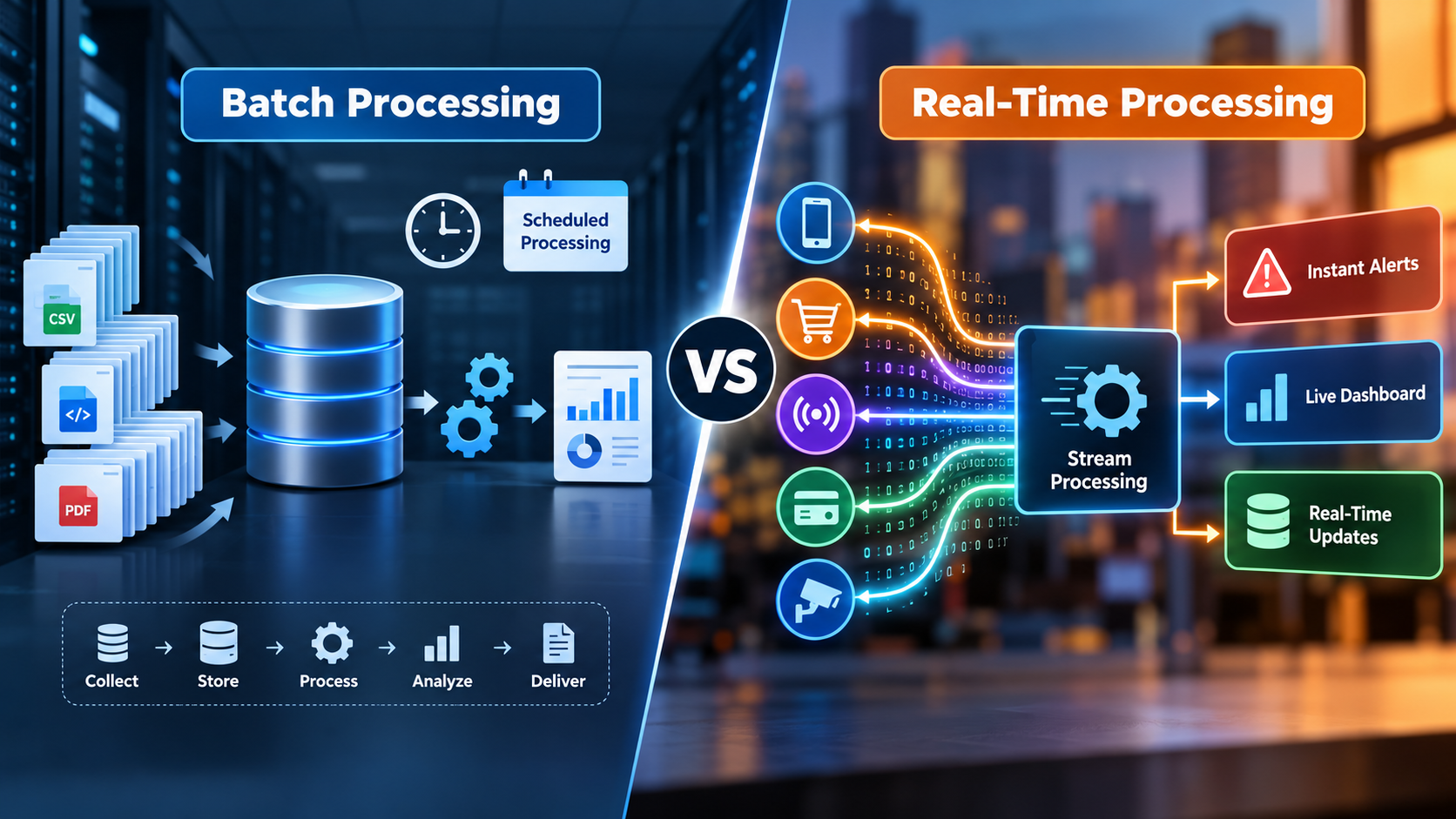
- Metadata harvesting: the tool reads schemas, table definitions, and job configurations from your systems.
- Query parsing: many tools read SQL and transformation code to see which columns feed which outputs.
- Runtime capture: instrumented jobs emit events as they run, which records what actually happened.
Open standards help here. OpenLineage is an open standard for lineage metadata collection. It models jobs, runs, and datasets, and it lets tools extend the model with facets, which are extra pieces of metadata. It is a graduate project of the LF AI & Data Foundation. Standards like this let different tools share lineage instead of each building private integrations.
The result usually appears as a lineage graph. Boxes show datasets or jobs, and arrows show the direction of flow. Start from the object you care about, then expand upstream or downstream one step at a time.
Data Lineage Use Cases
Marketing and CRM Reporting
Campaign reports often combine CRM records, ad platform data, and web analytics. Lineage shows which fields feed attribution and where definitions drift. Pairing it with data analytics services helps teams keep those definitions consistent across tools.
Dashboard Trust
Every chart is the end of a long path. Lineage lets a viewer click through to the sources behind a visual. Teams building executive views in Tableau can combine lineage with Tableau consulting services to document which data sources feed each workbook. For design and storytelling on top of that foundation, see data visualization services.
Financial and Regulatory Reporting
Finance teams use lineage to document how reported figures were produced, which shortens audit preparation and reduces manual evidence gathering.
Migrations and Modernization
Before moving systems, teams map dependencies so they migrate related pipelines together and retire unused ones with confidence.
Privacy Requests
Lineage points to every system that holds a person’s data, which makes access and deletion requests faster to complete.
Data Lineage for AI and Machine Learning
Most lineage guides stop at dashboards. AI work needs more.
A model depends on training data, features, and prompts or retrieval sources. If a source changes or contains errors, model outputs shift, and nobody can explain why without a record. Lineage for AI answers practical questions:
- Which datasets trained or fine-tuned this model?
- Which features come from which source columns?
- Which documents feed this assistant’s answers?
- What changed before the output quality dropped?
Practical Example: Tracing an Outdated Source in an AI Assistant
Consider an AI assistant that answers customer questions using a company’s internal policies and support documents. One day, it provides an outdated refund policy because an older document is still available in its retrieval system.
Without proper lineage records, the team may struggle to identify which document influenced the answer. When the system records its retrieval sources, data lineage helps the team trace the information used, identify the outdated document, and check when the source was last updated.
The team can then replace or remove the outdated material, refresh the relevant data pipeline, and test whether the assistant retrieves the correct policy. Recording these changes also makes future investigations easier when answer quality declines or policy information changes.
This approach is particularly useful for retrieval-augmented generation (RAG) systems, internal knowledge assistants, and AI-powered customer support tools. Data lineage improves traceability, although answer quality still depends on source accuracy, retrieval quality, and appropriate testing.
Governance guidance for AI points the same way. The NIST AI Risk Management Framework stresses documentation and governance across the AI lifecycle, and traceable data is part of that documentation. Teams building AI and machine learning solutions benefit from capturing lineage from day one, and teams building autonomous workflows through agentic AI services need it to audit what an agent read before it acted.
Data Lineage Best Practices
1. Start With a Business Question
Pick one high-value target, such as the board revenue report or a regulated dataset. A narrow start produces a useful map quickly and builds support for more.
2. Identify Critical Data Elements
List the fields that drive major decisions or carry sensitive information. Map those first, and use column-level lineage for them.
3. Assign Owners
Name an owner for every dataset and a steward for every business definition. A map without owners ages fast.
4. Capture Lineage Automatically Where You Can
Use automated capture for warehouses, pipelines, and BI tools. Reserve manual documentation for spreadsheets and legacy systems that tools cannot read.
5. Connect Business and Technical Views
Link technical objects to business terms so analysts can search by meaning, not by table name.
6. Build Lineage Into Change Management
Require an impact check from the downstream view before anyone changes a pipeline, schema, or metric definition.
7. Review on a Schedule
Systems change monthly. Check coverage and accuracy on a set cadence and fix gaps before they spread.
8. Measure Adoption
Track whether people actually use the map. Useful signals include fewer repeated debugging requests and faster audit responses.
Common Mistakes to Avoid
- Trying to map the whole company in the first phase.
- Buying a tool before defining the questions it must answer.
- Ignoring spreadsheets and manual steps where errors often start.
- Skipping ownership, so nobody maintains the map.
- Treating lineage as a one-time project.
Challenges and Limitations
Data lineage delivers real value, but it has limits you should plan for.
- Legacy systems: older platforms may not expose metadata, so teams document them by hand.
- Hidden logic: transformations inside stored procedures, scripts, or third-party tools can hide connections from automated parsers.
- Spreadsheets and shadow data: copies outside governed systems break the chain.
- Cost and effort: column-level coverage across a large estate takes time and budget.
- Change management: people must update habits, such as checking impact before changes.
A realistic scope and clear owners reduce each of these risks.
How to Choose a Data Lineage Tool
Before comparing vendors, write down the questions you need answered. Then test each option against this checklist:
- Coverage: does it connect to your warehouse, pipeline tools, BI tools, and CRM?
- Depth: does it offer column-level lineage, and how does it handle code-based transformations?
- Automation: how much does it capture without manual mapping?
- Standards support: does it work with open standards such as OpenLineage?
- Usability: can business users explore the map without writing queries?
- Security: does it respect access controls and keep sensitive metadata protected?
- Cost model: how does pricing grow with data volume or users?
Some teams build on open-source components, while others buy a managed product. Build if you have engineering capacity and unusual needs. Buy if you need fast coverage across many systems. If you lack in-house capacity for either path, you can hire data analytics developers to set up and maintain the work.
Data Lineage vs Related Concepts: Comparison Table
Teams often mix up lineage with neighboring ideas. This table separates them.
| Concept | Main question it answers | Scope | Main users | Example |
| Data lineage | Where did this data come from, and where does it go? | Movement and transformation across systems | Data engineers, analysts, governance teams | Tracing a revenue figure back to its CRM source |
| Data provenance | What is the origin and custody history of this dataset? | Origin and history of a dataset | Researchers, auditors | Recording who collected a dataset and how |
| Data catalog | What data do we have, and what does it mean? | Inventory and descriptions of datasets | Analysts, business users | Searching for the approved customer table |
| Data observability | Is my data healthy right now? | Freshness, volume, and quality signals | Data engineers, operations teams | Alerting when a table stops updating |
| Data governance | Who decides how data is defined, protected, and used? | Policies, roles, and controls | Leadership, stewards, compliance | Setting rules for who may view customer records |
These concepts work best together. A catalog finds the data, lineage explains its path, observability watches its health, and governance sets the rules.
Frequently Asked Questions
Data lineage is a record of where data starts, how it changes, and where it ends up. It works like a map for your data. When a report shows a surprising number, lineage lets your team trace that number reliably back through every system and transformation to its original source.
Lineage means the line of descent or origin of something, such as a family tree or the history of an object. In data work, the idea carries over directly. Lineage describes the ancestry of a dataset: which sources fed it, which steps shaped it, and which people or tools touched it along the way.
In data governance, data lineage supports accountability. It shows who owns each dataset, which systems store it, and which rules apply along its path. Governance teams use lineage to prove where sensitive data flows, enforce policies, answer audit questions, and confirm that approved definitions reach every downstream report.
Data lineage builds trust in numbers. It speeds up error diagnosis, shows what a change will break before you make it, and supports compliance audits and privacy requests. It also keeps analytics and AI models grounded in known sources, which reduces costly rework and long arguments about whose figures are right.
The main types are business lineage, technical lineage, and operational lineage. You can also classify by detail, table-level or column-level, by direction, forward or backward, and by capture method, manual, pattern-based, or automated. Most teams combine several types at once, because each type answers a different kind of question and serves different people.
Column-level lineage tracks individual fields instead of whole tables. It shows which source columns feed a specific metric, such as revenue or customer age, and which calculations change them. This depth helps with impact analysis and privacy work, because you can find exactly where one sensitive field travels. Table-level views are simpler but less precise.
Data provenance records the origin and custody history of a dataset, often for authenticity and research reproducibility. Data lineage covers similar ground but focuses on movement and transformation through systems for operational use. Many teams use the terms loosely, yet provenance stresses where data came from and lineage stresses how it traveled.
A data catalog is an inventory that helps people find and understand datasets. Data lineage adds the connections between those datasets and shows how data flows. Many catalogs offer lineage views, but a catalog without lineage tells you what exists, while lineage tells you where it came from and what depends on it.
Data governance or data engineering teams usually run the lineage program, but ownership of the data itself belongs to named business data owners and stewards. Engineers keep the technical capture working, stewards review business meaning, and a governance lead sets scope and priorities. Shared accountability keeps the lineage accurate and used.
Start small. Pick one critical report or regulatory dataset, map its sources and transformations, and name an owner for each step. Then choose a capture method, automate where your tools allow, and review the map on a schedule. Expand gradually to more data domains only after the first map proves useful.
Conclusion
Data lineage turns a pile of disconnected systems into a map you can read. It shows where data starts, how it changes, and where it lands, so you can trust reports, fix errors faster, and change systems without surprises. It also gives governance, privacy, and AI work the traceability they depend on.
Start with one report that matters, map it end to end, name owners, and automate what you can. Expand only after the first map earns its keep. If you want help turning scattered data into reliable insight, explore the team’s data analytics services and start with a focused lineage scope.