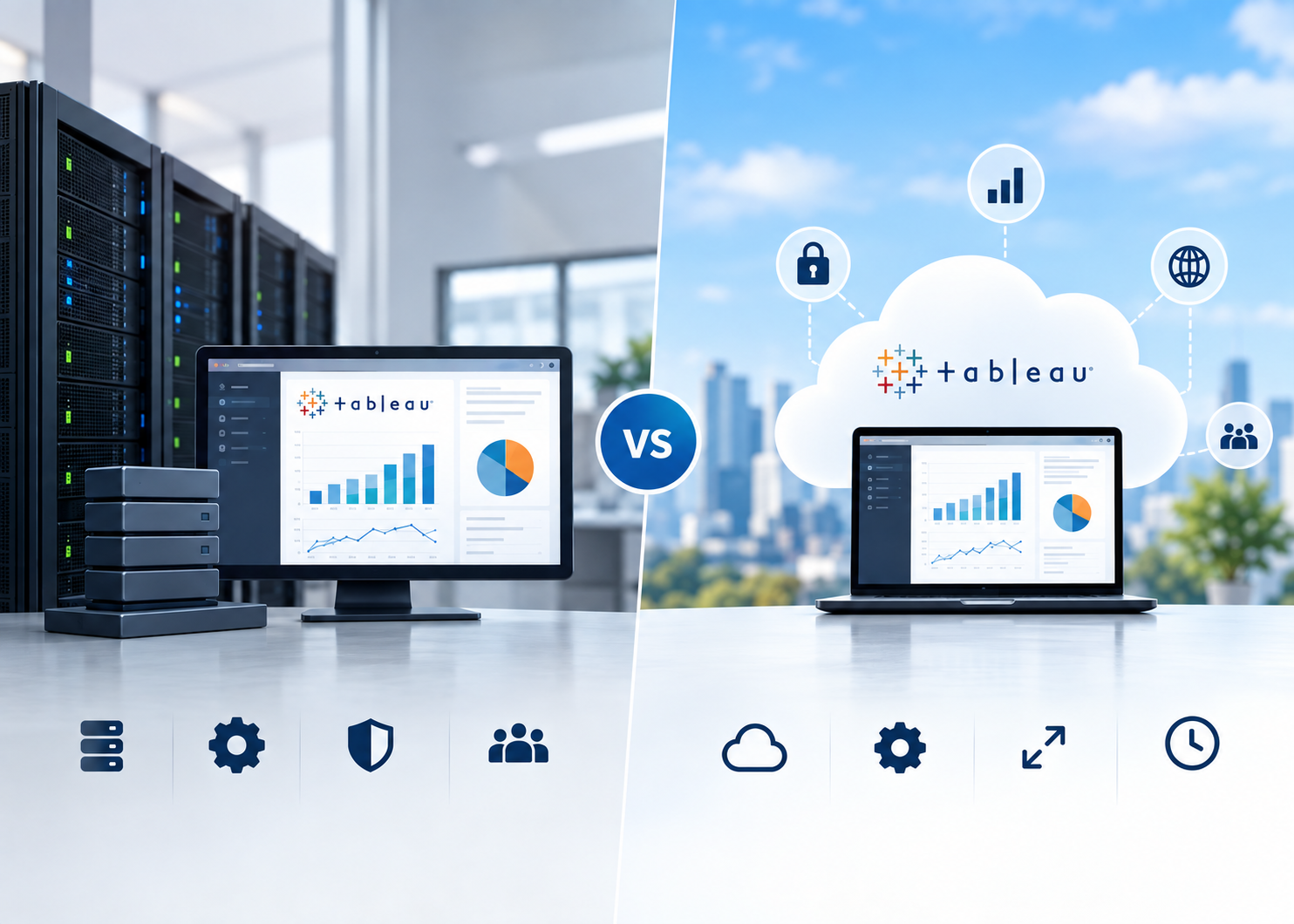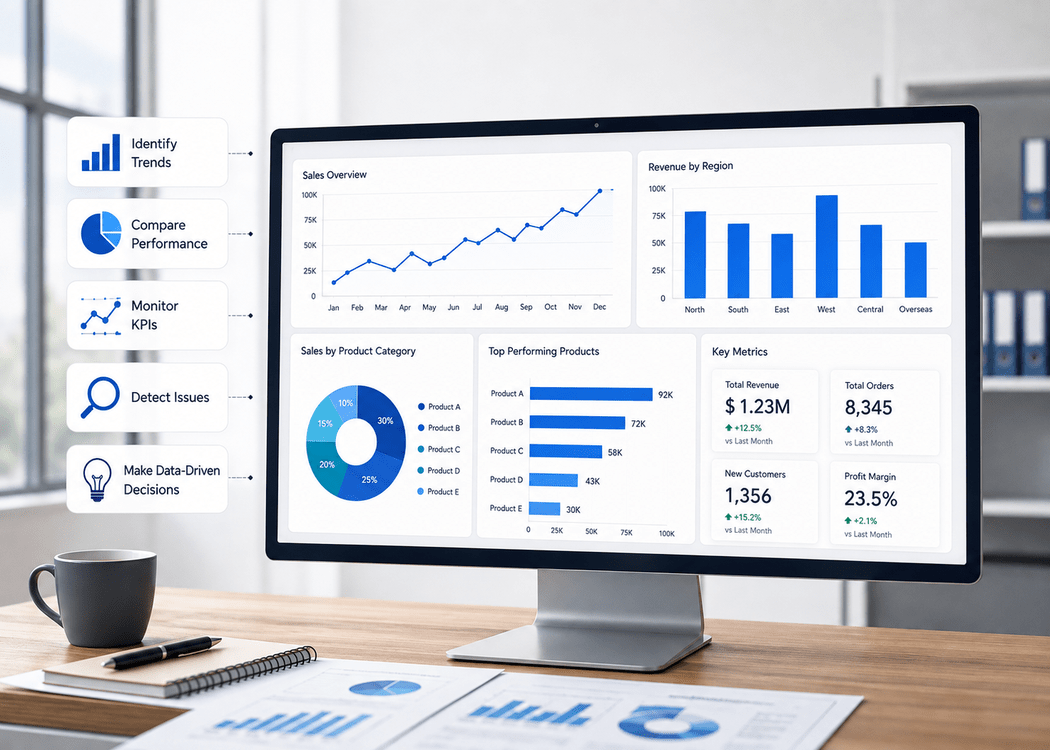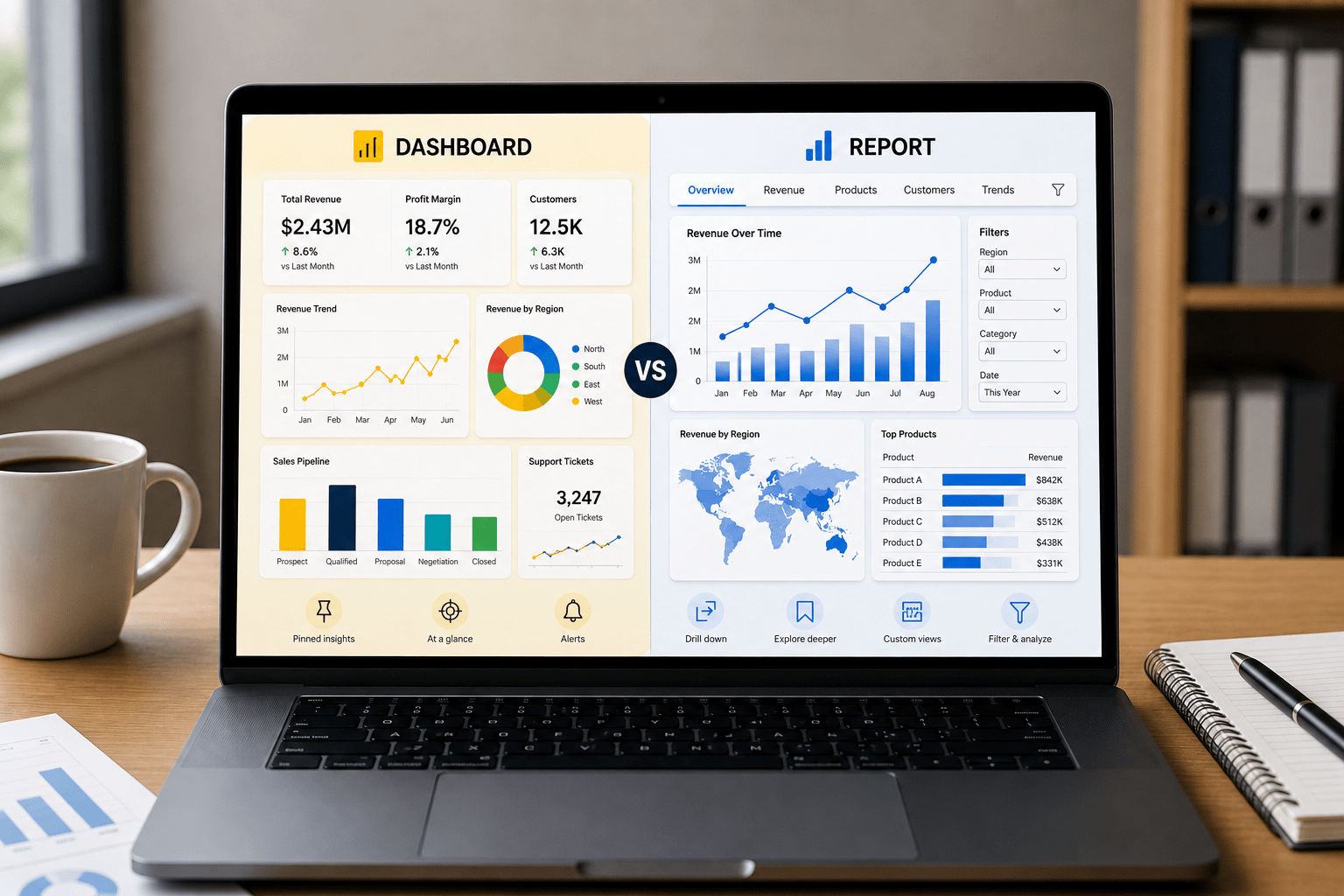
Choosing between Tableau Server and Tableau Cloud is an important decision for organizations building or modernizing a business intelligence environment. Both platforms support Tableau analytics, dashboards, data visualization, collaboration, and governed access to business information, but they differ significantly in how the environment is hosted, maintained, secured, upgraded, and scaled.
The central difference is the operating model. Tableau Server is self-managed, giving organizations control over the infrastructure and deployment environment. Tableau Cloud is a fully hosted analytics platform managed by Tableau, reducing the infrastructure responsibilities that come with running a server environment.
When comparing Tableau Server vs Tableau Cloud, it is important to look beyond the features offered by each platform. Data architecture, IT resources, governance requirements, connectivity, infrastructure control, upgrade management, scalability, and long-term operating needs can all influence which deployment approach is the right fit.
Tableau Server vs Tableau Cloud at a Glance
| Factor | Tableau Server | Tableau Cloud |
| Deployment | Self-managed | Fully hosted |
| Infrastructure | Managed by the organization | Managed by Tableau |
| Hosting | On-premises or customer-managed cloud infrastructure | Tableau-hosted cloud environment |
| Updates | Managed by the organization | Managed by Tableau |
| Infrastructure maintenance | Organization responsibility | Tableau responsibility |
| Backend control | Greater infrastructure-level control | More limited infrastructure-level control |
| Scalability | Requires capacity planning | Cloud-based scaling model |
| Data connectivity | Strong control over internal environments | Cloud and supported private-data connectivity options |
| IT workload | Higher | Lower infrastructure workload |
| Governance | Organization-managed | Organization-managed within a managed platform |
| Customization | Greater infrastructure flexibility | More standardized environment |
| Best fit | Organizations needing infrastructure control | Organizations wanting a managed analytics environment |
The table provides a starting point, but the differences become clearer when deployment, data connectivity, security, administration, and operational responsibilities are examined individually.
What Is Tableau Server?
Tableau Server is a self-managed platform for publishing, sharing, governing, and managing Tableau analytics. Organizations can deploy it within their own environments or on infrastructure they control in a public or private cloud.
Tableau describes Tableau Server as a self-managed enterprise analytics platform designed for organizations that need control and flexibility over their analytics environment.
With Tableau Server, the organization is responsible for the infrastructure and the operational environment surrounding the platform. Depending on the architecture, this can include server capacity, operating systems, networking, monitoring, upgrades, backups, security configuration, and high-availability planning.
How Tableau Server Works
A typical Tableau Server environment follows a structure such as:
Data sources → Data preparation → Tableau workbooks → Tableau Server → Users and dashboards
Organizations can connect Tableau Server to databases, data warehouses, files, applications, and other supported data sources. Published workbooks and data sources can then be managed centrally and accessed by authorized users.
Where Can Tableau Server Be Hosted?
Tableau Server can be deployed in different environments depending on organizational requirements, including:
- On-premises infrastructure
- Private cloud environments
- Public cloud infrastructure managed by the organization
- Hybrid environments
This flexibility can be important when an organization has specific infrastructure, network, data residency, or integration requirements.
What Is Tableau Cloud?
Tableau Cloud is Tableau’s fully hosted analytics platform. Instead of requiring an organization to operate Tableau Server infrastructure, Tableau manages the underlying hosted environment.
Tableau describes Tableau Cloud as a fully hosted analytics solution that provides analytics capabilities without the infrastructure overhead associated with running a self-managed environment.
Organizations still manage important areas such as users, permissions, content, data access, governance, and analytics adoption. However, the underlying platform infrastructure and many operational responsibilities are handled by Tableau.
How Tableau Cloud Works
A simplified Tableau Cloud workflow looks like this:
Business data → Data connection → Tableau Cloud → Published dashboards → Authorized users
Teams can publish workbooks and data sources, manage permissions, create dashboards, and collaborate through the hosted environment.
For organizations already using cloud databases and SaaS applications, Tableau Cloud can also fit naturally into a broader cloud analytics architecture.
Tableau Server vs Tableau Cloud: Key Differences
1. Deployment and Hosting
The biggest difference between Tableau Server and Tableau Cloud is the deployment model.
With Tableau Server, the organization manages the environment where Tableau is deployed. This provides more control over infrastructure configuration, networking, maintenance windows, and deployment architecture.
With Tableau Cloud, Tableau operates the hosted environment. The organization consumes the analytics platform as a managed cloud service instead of running the underlying Tableau infrastructure itself.
This distinction affects almost every other consideration in the comparison.
2. Infrastructure Management
Tableau Server requires an organization to plan and maintain infrastructure capacity. Depending on the deployment, this can involve:
- Server resources
- Storage
- Networking
- Operating systems
- Monitoring
- Backup processes
- High availability
- Disaster recovery
- Capacity planning
Tableau Cloud removes much of this infrastructure management from the organization’s responsibilities.
This does not mean that Tableau Cloud eliminates administration. Teams still need to manage users, permissions, content, data connections, governance, and adoption.
3. Software Updates and Upgrades
Another important difference is upgrade responsibility.
With Tableau Server, organizations control when and how they upgrade their environment. This can be useful when internal applications, integrations, testing processes, or governance requirements require a controlled release process.
Tableau Cloud follows a managed update model. Tableau manages the platform environment and delivers updates as part of the hosted service. Tableau’s current Cloud positioning emphasizes managed infrastructure and continuously evolving analytics capabilities.
The trade-off is straightforward: Server provides greater control over the upgrade process, while Cloud reduces the operational work associated with platform upgrades.
4. Security and Access Control
Security should not be reduced to the question of whether Server or Cloud is inherently more secure.
The relevant question is which security model fits the organization’s architecture and responsibilities?
With Tableau Server, organizations have greater control over the infrastructure, network environment, authentication architecture, and security configuration surrounding the deployment.
With Tableau Cloud, Tableau manages the hosted platform infrastructure, while the organization remains responsible for areas such as identity, permissions, content governance, and appropriate data access.
For organizations with strict network isolation, data residency, or infrastructure requirements, the deployment model needs to be evaluated alongside legal, security, and compliance requirements.
5. Data Connectivity
Data connectivity can become one of the most important considerations when comparing Tableau Server vs Tableau Cloud.
Tableau Server can be positioned close to internal databases and other systems because the organization controls the deployment environment.
Tableau Cloud is designed for cloud-based analytics, but organizations may still need to connect to data that resides in private networks or behind firewalls.
Tableau provides connectivity options such as Tableau Bridge for supported scenarios involving private network data sources.
Therefore, before selecting a platform, organizations should create an inventory of their data sources and determine:
- Where each data source is hosted
- Whether it is cloud-based or on-premises
- How authentication works
- Whether live connections are required
- Whether extracts are appropriate
- Whether private network connectivity is needed
- Whether the required connector is supported
This assessment can prevent connectivity issues later in a deployment or migration.
6. Scalability and Performance
Performance planning is different for each platform.
With Tableau Server, organizations need to consider infrastructure capacity, workload patterns, user concurrency, data volume, extract refreshes, and dashboard complexity.
Performance can also be influenced by the architecture of the underlying infrastructure and how Tableau Server is configured.
With Tableau Cloud, organizations do not manage the underlying Tableau infrastructure in the same way. However, dashboard design, query efficiency, data models, extracts, network conditions, and workload characteristics can still influence the user experience.
Good Tableau performance therefore depends on more than choosing Server or Cloud. Efficient data models, well-designed workbooks, appropriate calculations, and effective dashboard design remain important.
Tableau Server vs Tableau Cloud: Cost Considerations
The cost of Tableau Server vs Tableau Cloud depends on more than the license price. The current Tableau pricing shown for both platforms starts at $15 USD per user per month when billed annually, while the Enterprise edition is listed at $35 USD per user per month.
For Tableau Server, Tableau also lists a premium Server option with pricing available through its sales team. Because Server is self-managed, organizations should consider additional operational expenses such as infrastructure, cloud hosting where applicable, storage, monitoring, backups, security management, upgrades, disaster recovery, and IT administration.
Tableau Cloud follows a different cost structure because Tableau manages the underlying hosted infrastructure. The current pricing page shows Tableau Standard at $15 USD per user per month and Tableau Enterprise at $35 USD per user per month, both billed annually. Tableau Cloud+ and the Tableau+ Bundle are listed as Contact Sales options.
However, the subscription price is only one part of the overall cost. Organizations using Tableau Cloud should also consider user licensing, data connectivity, implementation, administration, integrations, and ongoing analytics management.
For Tableau Server, the additional infrastructure and administration requirements can increase the overall operating cost, while Tableau Cloud can reduce the amount of infrastructure management handled internally. Therefore, organizations comparing the two should consider total cost of ownership, including licensing, infrastructure, IT resources, maintenance, and long-term operational requirements.
Tableau Server vs Tableau Cloud for Different Business Scenarios
There is no single deployment model that fits every organization.
Organizations With Extensive On-Premises Data
Tableau Server may fit environments where a large portion of critical data remains within controlled internal infrastructure and the organization wants direct control over the analytics environment.
Tableau Cloud can still be considered, but connectivity architecture should be assessed carefully.
Cloud-First Organizations
Organizations that already operate primarily in cloud databases, SaaS applications, and cloud infrastructure may find the managed operating model of Tableau Cloud easier to align with their broader technology strategy.
Organizations With Limited IT Resources
Tableau Cloud can reduce the infrastructure responsibilities associated with running a Tableau Server environment. This can allow internal teams to spend more time on analytics, governance, and business requirements rather than server operations.
Organizations Requiring Infrastructure-Level Control
Tableau Server provides greater control over the deployment environment. This can matter when organizations need specific networking, infrastructure, deployment, or operational configurations.
Organizations With Complex Governance Requirements
Governance should be evaluated based on the organization’s actual requirements rather than assuming that one deployment model automatically satisfies them.
Review:
- Data residency
- Identity management
- Access controls
- Audit requirements
- Network architecture
- Regulatory requirements
- Data classification
- Retention requirements
Tableau Server vs Tableau Cloud: Migration Considerations
Some organizations evaluating Tableau Cloud are already running Tableau Server.
Moving from Server to Cloud is not simply a matter of copying dashboards. A migration should evaluate the entire analytics environment.
Important areas include:
Existing Workbooks
Identify which workbooks are actively used, which are outdated, and which should be redesigned before migration.
Data Sources
Review databases, extracts, published data sources, credentials, connection methods, and refresh schedules.
Users and Permissions
Map users, groups, roles, projects, and permissions to the target environment.
Authentication
Review the existing identity architecture and determine how users will authenticate in the new environment.
Integrations
Inventory APIs, embedded analytics, automation scripts, extensions, subscriptions, and third-party integrations.
Data Connectivity
Determine whether private data sources require additional connectivity architecture such as Tableau Bridge.
Testing
A migration should include validation of:
- Dashboard calculations
- Filters
- Data freshness
- Refresh schedules
- Permissions
- Embedded content
- User access
- Performance
A phased migration can reduce disruption by allowing teams to test a smaller group of workbooks and users before expanding the migration.
Tableau Server vs Tableau Cloud: Governance Considerations
Governance remains important regardless of the deployment model.
A strong Tableau governance framework can address:
- Who can publish content
- Who can create certified data sources
- How projects are organized
- How permissions are assigned
- How sensitive data is handled
- How dashboards are reviewed
- How unused content is managed
- How data quality is monitored
- How analytics definitions are standardized
The platform provides capabilities, but governance also depends on organizational processes.
For example, a technically well-configured Tableau environment can still become difficult to manage if every department creates duplicate dashboards using different definitions of the same KPI.
Tableau Server vs Tableau Cloud for Dashboard Performance
Platform selection is only one part of Tableau performance.
Dashboard performance can also depend on:
- Data source design
- Number of visualizations
- Complex calculations
- Filters
- Parameters
- Extract size
- Query performance
- Data freshness requirements
- Dashboard layout
- Number of concurrent users
This is why performance testing should happen before a large-scale deployment.
A dashboard that performs poorly on a well-managed environment may still need optimization at the workbook or data-model level.
Tableau Server vs Tableau Cloud: How to Decide
Instead of choosing a platform based on a single feature, evaluate your environment using the following questions:
- Where does most of your business data reside?
- Do you require infrastructure-level control?
- How much IT capacity is available for Tableau administration?
- Do you need control over upgrade timing?
- What are your data residency requirements?
- How complex are your internal data connections?
- Do you have strict network isolation requirements?
- How quickly do you need to scale analytics?
- How important is minimizing infrastructure maintenance?
- What is the total cost of ownership over several years?
The answers provide a more reliable basis for evaluating Tableau Server vs Tableau Cloud than comparing features in isolation.
Tableau Server vs Tableau Cloud: Pros and Considerations
Tableau Server
Potential advantages
- Greater infrastructure control
- Flexible deployment options
- Control over upgrade timing
- Greater ability to customize the environment
- Direct integration with controlled internal infrastructure
- More control over infrastructure-level administration
Considerations
- Requires infrastructure management
- Requires planned upgrades
- Requires capacity planning
- Requires monitoring and maintenance
- Requires internal operational expertise
Tableau Cloud
Potential advantages
- Fully hosted platform
- Reduced infrastructure management
- Tableau-managed platform updates
- Easier cloud-based access
- Reduced server administration
- Suitable for organizations following managed cloud strategies
Considerations
- Less infrastructure-level control
- Private data connectivity may require additional planning
- Upgrade timing is not controlled in the same way as Server
- Organizations still need strong governance and administration
- Data architecture must be reviewed before migration or implementation
Tableau Server, Tableau Cloud and the Changing Analytics Landscape in 2026
The Tableau ecosystem is evolving beyond traditional dashboard delivery.
Tableau’s 2026 product messaging increasingly emphasizes AI and agentic analytics alongside traditional visualization and business intelligence capabilities. Tableau Cloud is positioned as a fully hosted platform with embedded AI experiences, while Tableau Server continues to address organizations that require self-managed analytics with greater control and flexibility.
This means deployment decisions should consider not only today’s dashboards but also how an organization expects analytics to evolve.
Questions around AI capabilities, governance, data access, security, user adoption, and integration can become increasingly important as analytics platforms expand beyond static reporting.
How to Get the Most From Your Tableau Environment
Choosing between Tableau Server and Tableau Cloud is only the first step. Organizations also need to consider data connections, dashboard architecture, user permissions, performance, governance, and migration requirements. These areas can become more complex as the number of users, dashboards, and data sources increases.
Tableau experts can help organizations assess their existing analytics environment, identify technical requirements, plan a deployment or migration, and address dashboard performance or data integration challenges. This type of Tableau consulting support can be useful when an organization needs to align its Tableau environment with its data architecture and long-term analytics requirements.
The need for expertise can vary depending on the project. A small team with a straightforward data environment may be able to manage Tableau internally, while larger or more complex environments may benefit from specialized guidance during implementation, migration, optimization, or ongoing development.
FAQs
The main difference is how the analytics environment is hosted and managed. Tableau Server is self-managed, so the organization controls the deployment infrastructure and platform operations. Tableau Cloud is a fully hosted service managed by Tableau. Both support analytics, dashboards, collaboration, and governed access, but the infrastructure responsibilities are different.
Tableau Cloud and Tableau Server provide many similar analytics capabilities, including publishing, dashboard sharing, permissions, and collaboration. However, they are different deployment models. Tableau Cloud is hosted and managed by Tableau, while Tableau Server is deployed and operated by the customer. The distinction affects infrastructure control, maintenance, upgrades, and administration.
Tableau Cloud generally requires less infrastructure maintenance because Tableau manages the hosted platform. Tableau Server requires the organization to handle activities associated with its deployment, such as upgrades, infrastructure monitoring, capacity planning, and operational maintenance. Organizations still need to administer users, permissions, content, governance, and data connections on either platform.
Yes. Tableau Server can be deployed on infrastructure that an organization manages in a public or private cloud environment. This means cloud hosting does not automatically mean an organization is using Tableau Cloud. The key distinction is who manages the Tableau environment and its underlying infrastructure. Tableau Server remains self-managed.
Tableau Cloud can connect to supported data sources located in private networks, but the connectivity architecture needs to be evaluated. Tableau Bridge can provide connectivity for supported scenarios involving private network data. Before implementation, organizations should review their databases, network configuration, authentication requirements, refresh needs, and supported connectors.
Tableau Server provides greater infrastructure-level control because the organization manages the deployment environment. Teams can control areas such as infrastructure configuration, networking, maintenance planning, and upgrade timing. Tableau Cloud provides a managed environment, reducing infrastructure responsibilities but also limiting the organization’s direct control over the underlying hosted platform.
Tableau Server upgrades are managed by the organization, allowing teams to plan testing and deployment around internal requirements. Tableau Cloud follows Tableau’s managed update model. This reduces the operational work associated with upgrades and keeps the hosted platform current, while organizations have less control over the timing of platform updates.
Tableau Cloud can support enterprise analytics environments that want a fully hosted platform and reduced infrastructure management. Suitability depends on the organization’s data architecture, governance, security requirements, connectivity needs, user scale, and operating model. Enterprise teams should evaluate these requirements rather than selecting a deployment model based only on platform size.
Yes, organizations can plan a migration from Tableau Server to Tableau Cloud. However, migration requires more than moving workbooks. Teams should assess users, permissions, data sources, extracts, refresh schedules, authentication, integrations, embedded content, and private data connectivity. A phased assessment and testing process can help identify compatibility and operational issues before full migration.
Businesses should consider infrastructure control, data location, security requirements, governance, connectivity, IT resources, upgrade management, scalability, performance, disaster recovery, and total cost of ownership. The most appropriate deployment model depends on the organization’s technical and operational requirements. A structured assessment of these factors can provide a clearer decision than comparing features alone.
Conclusion
The Tableau Server vs Tableau Cloud decision is primarily a question of deployment, control, and operational responsibility. Tableau Server gives organizations greater control over their environment and infrastructure, while Tableau Cloud provides a fully hosted model that reduces the need to manage Tableau infrastructure directly. Both can support enterprise analytics, but they fit different operating requirements.
Before selecting a platform, organizations should evaluate their data architecture, governance requirements, connectivity, IT capabilities, security needs, upgrade preferences, scalability expectations, and long-term costs. Taking this broader view helps ensure that the Tableau environment supports not only current dashboards and reporting requirements but also the organization’s future analytics strategy.