Salesforce’s own help documentation caps the free version of Einstein Prediction Builder at 10 predictions built and just one enabled at a time, which surprises a lot of admins who expect a fully open sandbox to experiment in. That limit shapes almost every early decision about how to use the tool, from which use case to test first to when a paid license actually becomes worth the conversation.
That is the kind of detail that gets lost in most guides written about Salesforce Einstein Prediction Builder. This one is different. It walks through what the tool actually does, where it genuinely helps a sales or service team, and where it falls short, based on how Salesforce documents the feature and how admins who use it every day describe working with it.
What Is Einstein Prediction Builder?
Einstein Prediction Builder is a point-and-click tool inside Salesforce that lets admins build custom prediction models on their own CRM data, without writing a line of machine learning code. You pick an object, like Lead or Opportunity, choose what you want to predict, such as whether a lead will convert, and Salesforce handles the data prep, model training, and scoring behind the scenes.
Two kinds of Einstein Prediction Builder predictions are supported today.
- Yes/no predictions, where the model estimates the probability that something happens, like a case escalating or a customer churning
- Numeric predictions, still in beta, where the model forecasts a number, such as expected deal size or units sold
Both run on top of standard Salesforce data, using fields you already have on Account, Contact, Lead, Opportunity, Case, and most other standard and custom objects.
Where Salesforce Einstein Prediction Builder differs from Einstein Discovery is scope. Discovery was built for deeper statistical storytelling across CRM Analytics datasets. Prediction Builder is scoped for admins who want one focused prediction, deployed as a field directly on a record, without a data science background. If your team already relies on Salesforce Einstein Discovery and Predictions for broader analytics, Prediction Builder is often the faster, lighter option for a single well-defined question.
How Einstein Prediction Builder Actually Works
The setup follows a guided path inside Setup, and it is worth walking through because each step is where most prediction accuracy problems start or get avoided.
1. Plan the prediction
Before touching the builder, decide exactly what outcome you are predicting and which object holds it. A vague goal like “predict sales” will not work. A specific one, like “predict whether an Opportunity closes within 90 days,” will.
2. Segment the data, if needed
Predictions can be scoped to a subset of records, such as only Opportunities from a specific business unit, so the model does not learn from records that behave differently.
3. Check your data
Einstein Prediction Builder runs a data checker that flags whether you have enough history and clean enough fields to train a reliable model. This is where the minimum record counts matter most.
4. Define the prediction set
You tell Salesforce which field to predict and which fields to consider as potential predictors. Fields with too many blanks or too little variation get flagged automatically.
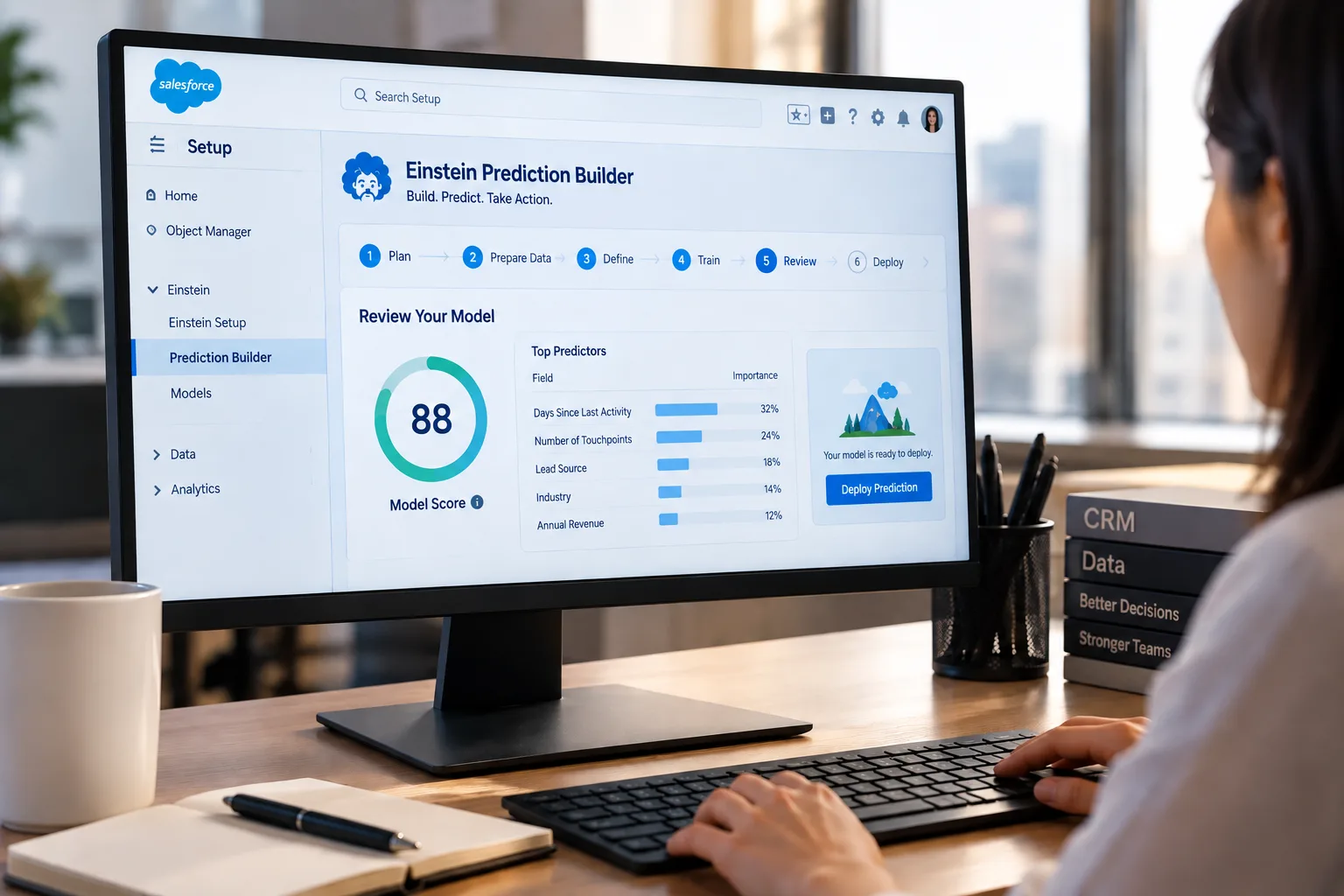
5. Review the scorecard
Once training finishes, Salesforce shows a model score on a 0 to 100 scale, along with a list of the strongest predictors and how much weight each one carries. This scorecard is the main way you judge whether a model is ready to deploy or needs more work.
6. Deploy the prediction
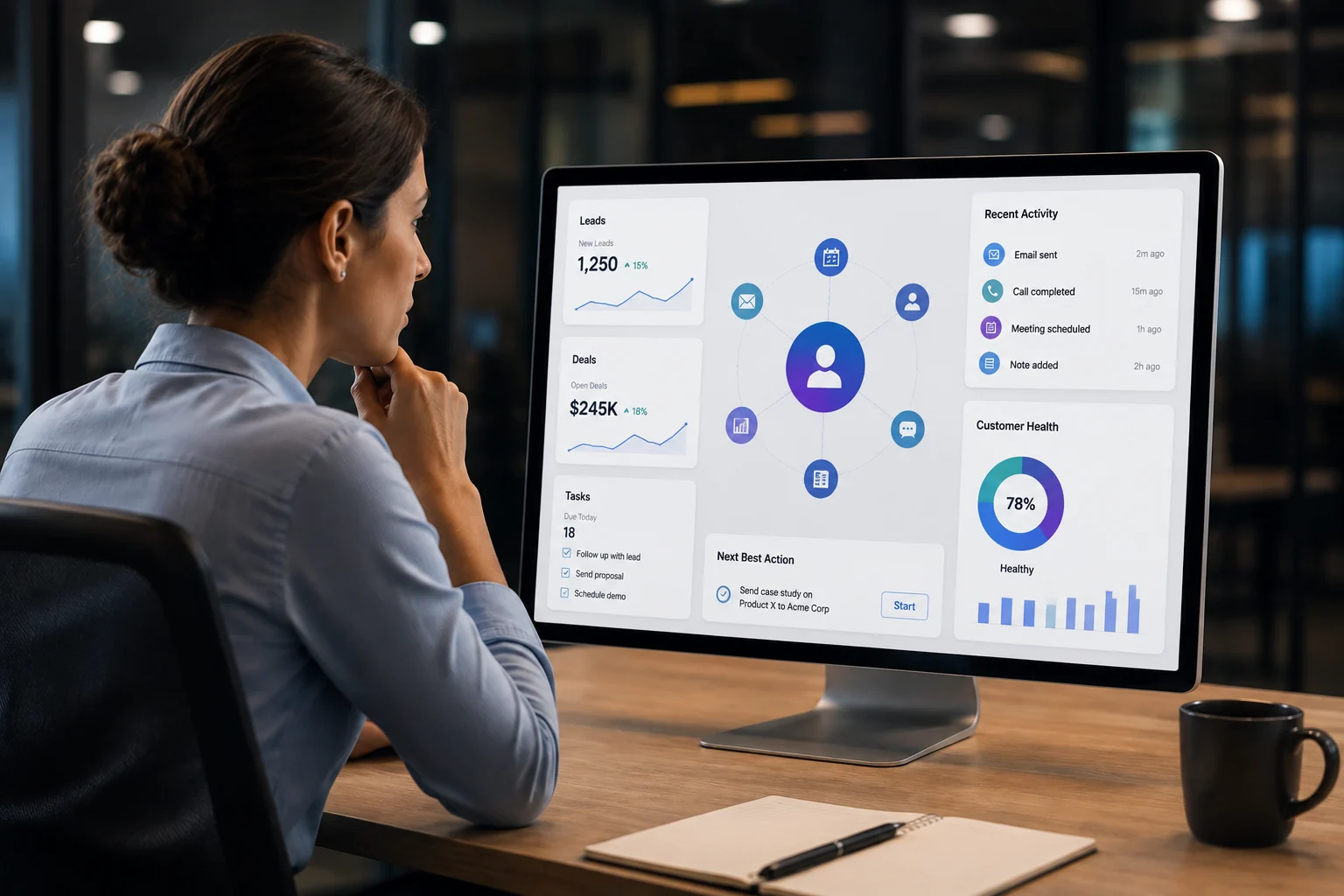
An enabled prediction writes its score to a field on the record, which you can then surface on page layouts, use in list views and reports, or feed into Salesforce Flow and Einstein Next Best Action for automated follow-up.
Benefits of Einstein Prediction Builder
No-code predictive modeling
The biggest draw of Einstein Prediction Builder is that a Salesforce admin, not a data scientist, can build a working model. There is no need to export data, choose an algorithm, or tune parameters. Salesforce handles that layer internally.
Predictions live where the work happens
Scores show up directly on the record, inside the same Opportunity, Lead, or Case page reps already use. Nobody has to open a separate analytics tool to see a churn risk or conversion score.
Transparent, explainable output
The scorecard shows which fields are driving a prediction and by how much, which matters for trust. A sales manager can see that “days since last activity” is the top predictor of a stalled deal, rather than being handed a black-box number with no explanation.
Built on data you already have
Because it reads directly from Salesforce objects, there is no separate data pipeline to maintain. If your CRM data is reasonably clean, the tool can start producing predictive insights without new infrastructure.
Fits into existing automation
Prediction scores can trigger Salesforce automation through Flow, populate dashboards, or feed Einstein Next Best Action, so a prediction becomes an action instead of just a number sitting on a page.
Low barrier to experimentation
The free “Try Einstein” tier lets you build up to 10 predictions and keep one active at a time, which is enough room to test a real use case before deciding whether a paid license is worth it.
Use Cases Worth Building First
Some predictions consistently deliver more value than others, based on where teams tend to see the fastest return.
- Lead conversion prediction. Scoring leads by likelihood to convert helps sales development reps prioritize outreach instead of working a list in order of creation date. This is one of the most common lead scoring use cases for the tool.
- Opportunity conversion prediction. Flagging which open Opportunities are most likely to close, and which are at risk of stalling, gives managers an early signal instead of waiting for a forecast call to find out a deal has gone quiet.
- Customer churn prediction. For subscription and service businesses, a customer churn prediction model built on support ticket history, product usage fields, and renewal dates can flag at-risk accounts early enough for a success team to intervene.
- Sales forecasting support. While Prediction Builder is not a full forecasting engine, a numeric prediction on expected deal value adds a useful data point alongside rep-submitted forecasts, especially for revenue prediction at the individual Opportunity level.
- Customer lifetime value estimates. A numeric model trained on past purchase history can estimate future value per account, which is useful input for deciding where to invest renewal or upsell effort.
- Case escalation and service prioritization. On the service side, a yes/no prediction on whether a case is likely to escalate helps support leads route the right cases to senior agents before they become a bigger problem.
Teams already running predictive analytics initiatives on top of Sales Cloud or Service Cloud tend to layer Prediction Builder in as the “quick win” model, while reserving deeper statistical work for CRM Analytics. If you are weighing that split for your own org, our Salesforce Einstein benefits breakdown covers how the different Einstein tools divide that work.
Limitations of Einstein Prediction Builder
- Minimum data requirements are strict. Salesforce requires at least 400 records in the overall dataset, or in each segment if the data is segmented, and at least 400 example records with a known outcome. For yes/no predictions, each outcome value needs at least 100 supporting records. Smaller Salesforce orgs, or newer ones without much history, often cannot meet this threshold yet.
- Limited to a two-year data window by default. Einstein Prediction Builder only considers records created or modified in the last two years unless that is adjusted, which can leave out relevant older history for businesses with long sales or renewal cycles.
- Numeric predictions are still in beta. Yes/no predictions are the most mature model type. Numeric predictions, useful for things like deal value or expected revenue, remain in beta, which means the underlying quality checks and guidance are less complete.
- Only certain field types are supported. The tool can predict checkbox fields and specially constructed formula fields, plus numeric fields in beta. It is not built to predict free text, picklists with many values, or unstructured content.
- Object coverage is fixed. Prediction Builder works with all custom objects but only a defined list of standard objects, including Account, Contact, Lead, Opportunity, Case, Contract, Order, and a handful of others. If your use case sits on an object outside that list, the tool cannot be used at all.
- License caps limit scale. The free tier allows up to 10 predictions built with one active at a time. A paid Einstein Predictions license raises that to 20 built and 10 active. CRM Analytics Plus goes further, to 45 built and 35 active. For an org that wants dozens of predictions running simultaneously, licensing becomes a real planning factor, not an afterthought.
- Scorecard detail is capped at 100 predictors. If a model has more than 100 predictors, the scorecard only shows the top ones ranked by impact and correlation, so very complex models lose some visibility into lower-ranked factors.
- Predictions do not carry over to sandboxes automatically. A prediction built in production has to be rebuilt in sandbox using copied licenses, which adds friction to testing changes before they go live.
- Data quality still drives outcomes. No-code does not mean no-effort. A model trained on inconsistent, sparse, or poorly maintained fields will produce a low score no matter how well the tool itself works. Getting real value out of automated predictions still depends on the underlying Salesforce CRM data being reasonably clean.
Einstein Prediction Builder vs Einstein Discovery vs CRM Analytics
These three sit at different points on the same spectrum, and mixing them up is a common source of confusion.
Einstein Prediction Builder
Built for a single, well-defined prediction deployed directly onto a Salesforce record, managed entirely by an admin through clicks.
Einstein Discovery
Now part of CRM Analytics, it goes deeper. It can analyze a dataset for statistical drivers, generate a narrative explanation of what is influencing an outcome, and support more advanced model types, but it typically requires more setup and a better grasp of the underlying data.
CRM Analytics
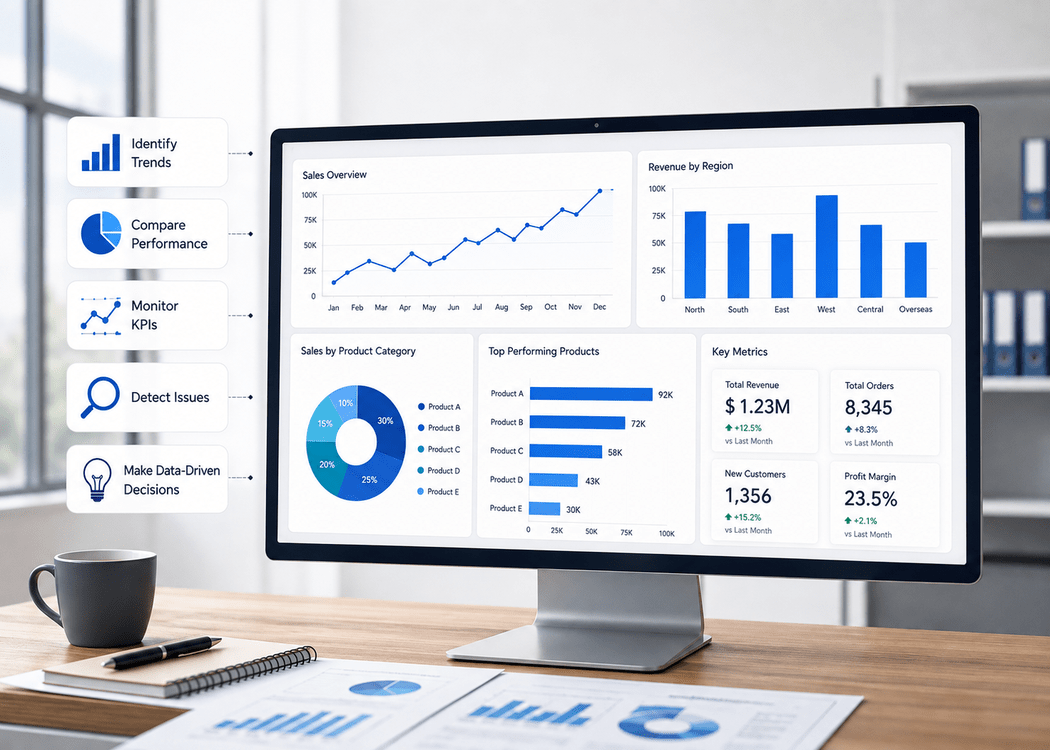
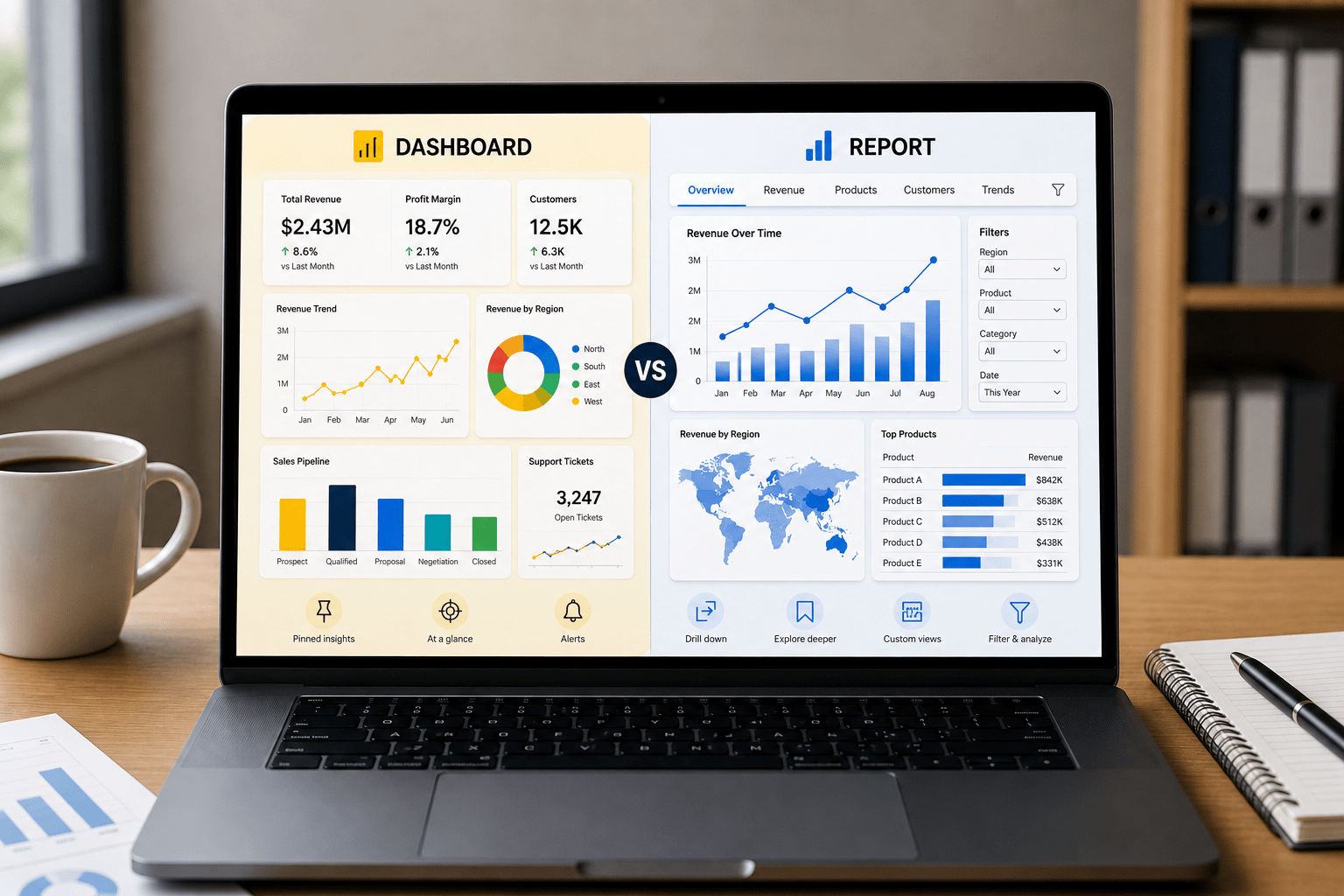
The broader analytics platform, combining dashboards, datasets, and Discovery-powered predictions for organizations that need more than a single deployed score.
For most teams, the practical decision comes down to scope. One clear question with a direct answer on a record points toward Prediction Builder. A broader analytics need, with multiple stakeholders wanting a dashboard and a story behind the numbers, points toward CRM Analytics and Discovery. Our earlier comparison of Salesforce Einstein versus custom AI models covers a related decision point, for teams weighing native Einstein tools against a fully custom-built model.
Getting the Most Out of Einstein Prediction Builder
A few practices consistently separate a useful model from one that gets built once and ignored.
- Start with a narrow, specific question rather than a broad one. “Will this lead respond to our next email” trains better than “will this lead be valuable.”
- Involve the people who work the data every day, not just the admin building the model. A sales rep usually knows which fields are noisy or inconsistently filled in, and that context saves rework later.
- Refresh the underlying data regularly. Predictions trained on stale data drift, and Salesforce recommends updating datasets on a schedule so scores stay relevant as business conditions change.
- Treat the scorecard as a diagnostic tool, not just a pass or fail number. A lower score paired with a clear top predictor can still be useful, especially early on, while you refine the data behind it.
- Plan for licensing before you build ten test predictions and hit the free tier ceiling. Knowing whether you will need an Einstein Predictions or CRM Analytics Plus license later changes how you prioritize which models to build first.
If your org is earlier in that journey and still deciding where Salesforce AI fits into day-to-day analyst work, our piece on why Salesforce is used by data analysts walks through how predictive tools like this one fit alongside reporting and Data Cloud.
Frequently Asked Questions
Einstein Prediction Builder is used to build custom AI predictions directly on Salesforce data, such as whether a lead will convert, a case will escalate, or a customer will churn. It works without writing machine learning code, and once a prediction is enabled, its score appears as a field right on the record for reps and agents to use.
Einstein Prediction Builder is available in Enterprise, Performance, Unlimited, and Developer editions. A free “Try Einstein” tier lets any admin in those editions build predictions and test the feature at no cost, before deciding whether an Einstein Predictions or CRM Analytics Plus license is worth adding later for more predictions and higher active limits.
Salesforce requires at least 400 records in the overall dataset, or in each segment if the data is segmented, plus at least 400 example records with a known outcome. Yes/no predictions also need a minimum of 100 records for each outcome value, so smaller or newer orgs may not qualify yet.
Yes, through numeric predictions, which are currently a beta feature inside Einstein Prediction Builder. Instead of estimating a probability, a numeric prediction forecasts a value, such as expected deal size or units sold. Yes/no predictions remain the more mature model type, with more complete quality checks and setup guidance built around them today.
Einstein Prediction Builder supports all custom objects, plus a defined list of standard objects that includes Account, Contact, Lead, Opportunity, Case, Contract, Order, and several others. If your use case sits on a standard object outside that list, the tool cannot currently be used for it at all, no matter how the data is structured.
6. How many predictions can I build for free?
The free “Try Einstein” tier allows up to 10 predictions to be built, with only one enabled at a time. Paid licenses raise those limits considerably: an Einstein Predictions license allows 20 built and 10 enabled, while CRM Analytics Plus allows 45 built and 35 enabled at once, for orgs running many predictions in parallel.
Prediction Builder is scoped for one specific, admin-built prediction deployed as a field on a record, using only clicks. Einstein Discovery, now part of CRM Analytics, goes further, supporting deeper statistical analysis, narrative explanations, and prescriptive suggestions across broader datasets, though it usually needs more setup time and data expertise to run well.
Check the scorecard that appears after training finishes. It shows an overall model score on a 0 to 100 scale, along with a ranked list of the strongest predictors and how much weight each one carries, which together tell you both how reliable the model is and what is driving it.
No, predictions built in a production org are not copied to sandbox orgs automatically. To use one in sandbox, you need to copy your licenses over from production first, then rebuild the prediction there from scratch, ideally in a recently refreshed full sandbox rather than a partial or older one.
It can still work with imperfect data, but quality has a direct effect on results. Fields with too many blanks or too little variation get flagged during the data check step, and a model trained on inconsistent or sparse data will return a lower score no matter how well the tool itself performs.
Conclusion
Einstein Prediction Builder earns its place in a Salesforce org when the goal is specific: one prediction, deployed on one object, understood by the team using it. It removes the need for a separate data science project, and it puts the score exactly where people already work, on the record itself.
That said, it has real limits around data volume, supported objects, and license caps, so a model built on thin or messy data will still score low no matter how the tool performs. Knowing those limits before you start is usually what separates a prediction that gets adopted from one that gets built once and forgotten. If you want help going further, OzaIntel’s Salesforce team can build the prediction model and turn it into a dashboard your team actually uses day to day.